
Vatican self-guided walking tour · about 75 minutes · map
The Vatican on foot: Castel Sant'Angelo, St Peter's and the Vatican walls
This walk goes from Hadrian's tomb on the Tiber to the wall of Vatican City. You pass Bernini's angels, an avenue begun under Mussolini, St Peter's Square and the Swiss Guard. It stays outside the paid sights, so you can enter or skip any of them.
Vatican City covers 44 hectares and is the smallest country in the world. Visitors from Rome walk in with no passport check, and public access to St Peter's Square and the basilica is free. The district around you is Borgo, which grew up on the pilgrim route to St Peter's. Most of what you see between the river and the square is newer than it looks: Via della Conciliazione dates from 1936 to 1950.
A note on accuracy: the long avenue and its lamps are 20th century, and the Passetto and the Swiss Guard are seen from outside. Where something is not the original, we say so, and every fact links to its source.
- Start
- Piazza di Ponte Sant'Angelo, at the south end of the bridge
- Finish
- Vatican Museums entrance, Viale Vaticano
- Distance
- 2.5 km, one way
- Time
- About 75 minutes: 33 min walking and 8 stops, plus any visit to the castle, basilica or museums
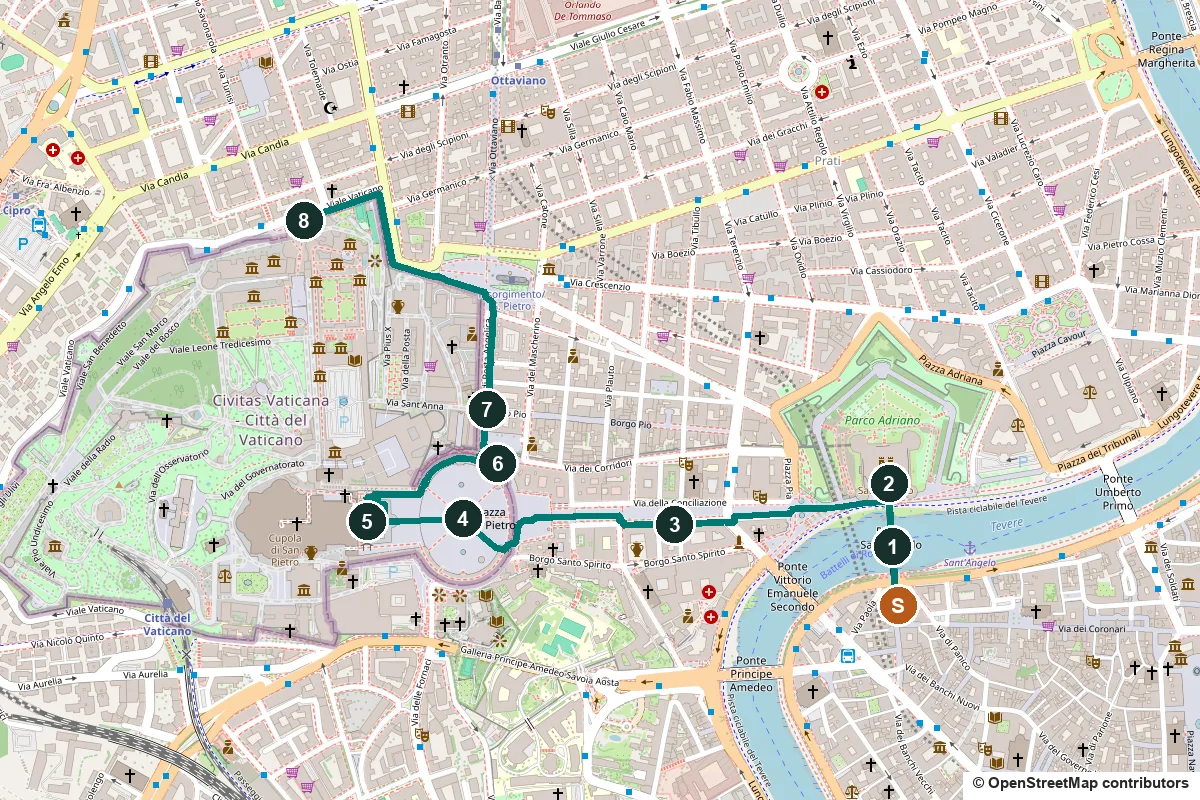
Terrain, water, opening days and a shorter version ↓
What to see: the stops
-
Ponte Sant'Angelo and Bernini's angels
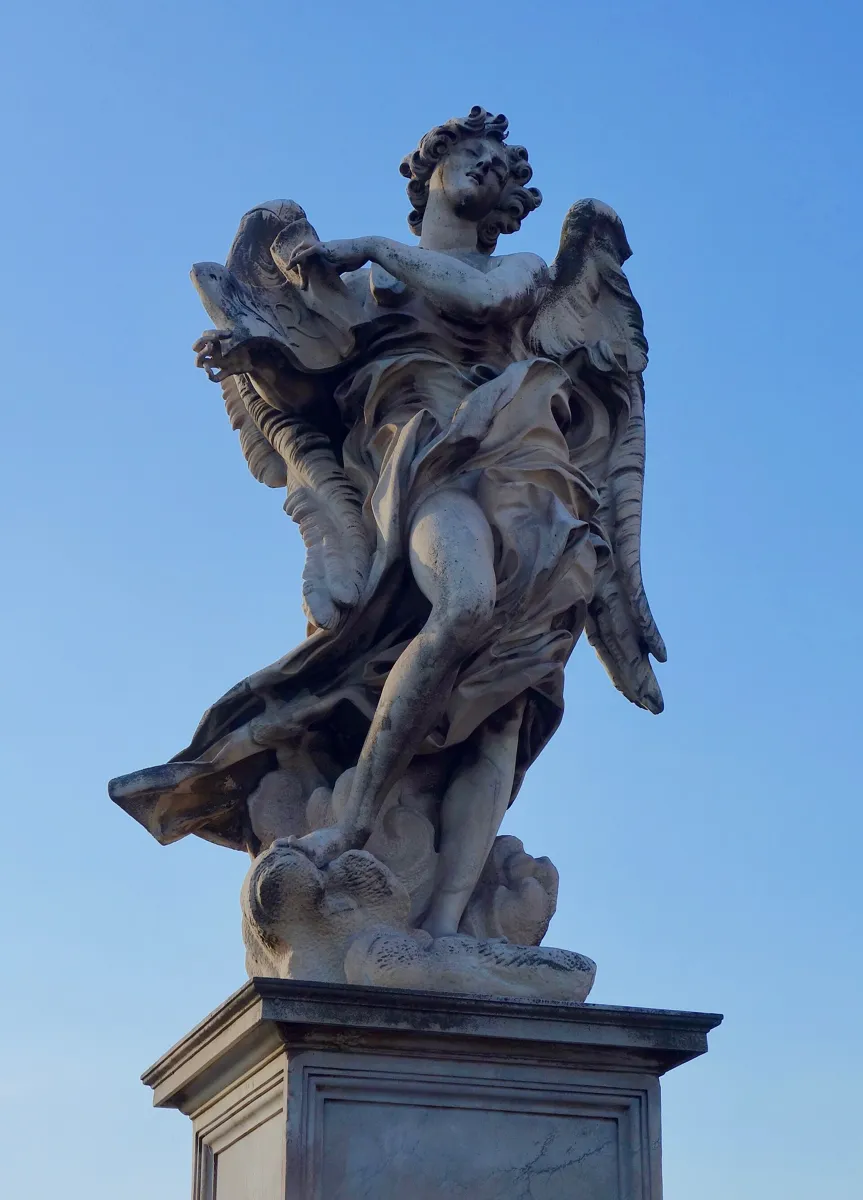
The Angel with the Superscription. Photo: Sonse, CC BY 2.0, via Wikimedia Commons (resized). Start in Piazza di Ponte Sant'Angelo and walk along Via del Banco di Santo Spirito to the bridge. Hadrian had it built in the 130s AD to link the city to his tomb, and it is now for pedestrians only. Three of its five arches are Roman. The ten angels along the parapet carry the instruments of Christ's Passion. Pope Clement IX ordered them in 1667 and they went up in 1670. Bernini directed the work, but his pupils carved most of them. He made two himself, the Angel with the Superscription and the Angel with the Crown of Thorns, and they were judged too fine to leave in the weather. They are in the church of Sant'Andrea delle Fratte, and copies stand here. The statues stand high on purpose, so you see them against the sky. At the near end of the bridge stand St Peter and St Paul, placed there in 1535.
More history
Pilgrims crossed here for centuries. In the Jubilee of 1450 the crowds broke the parapets and 172 people died; houses at the bridge head were then pulled down to give the crowd room. Dante describes the two-way flow of pilgrims in the Jubilee of 1300. For a long time the bodies of executed criminals were displayed on the bridge. The Roman ramps at each end were replaced by arches in 1893, when the river embankments were built, and the riverside between bridge and castle became pedestrian in 2000.
Sources: Wikipedia, Ponte Sant'Angelo; Wikipedia (it), Ponte Sant'Angelo.
-
Castel Sant'Angelo, Hadrian's tomb turned papal fortress
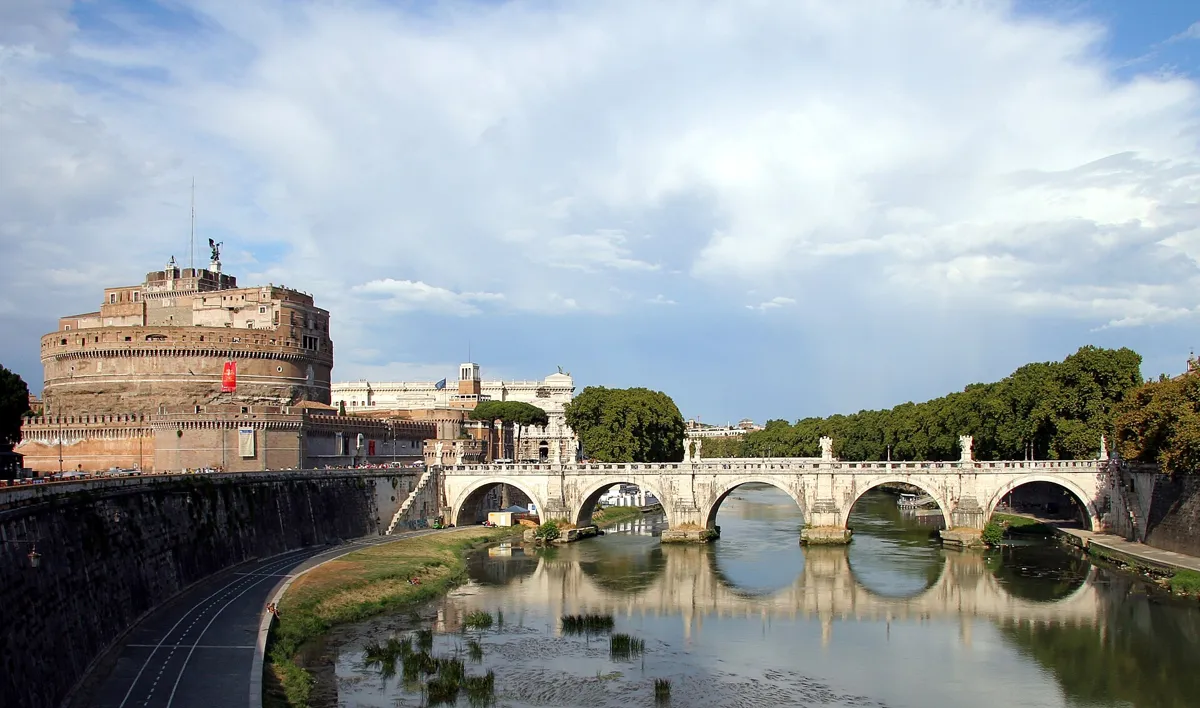
The castle and bridge from across the Tiber. Photo: AngMoKio, CC BY-SA 2.5, via Wikimedia Commons (resized). Cross the bridge to the castle. Hadrian began it as a tomb for himself and his family, and it was finished in 139 under his successor, Antoninus Pius. Its top was a garden mound with a bronze chariot. The ashes of emperors were placed here until Caracalla in 217. In the early 5th century the tomb became a fortress inside the city walls. The name comes from a legend: in 590, during a plague, Pope Gregory I saw the archangel Michael sheathe his sword above the building, and the plague ended. The bronze Michael on top today dates from 1753. Later the popes used the castle as a refuge, a treasury and a prison. Giordano Bruno was held here for six years, and the last act of Puccini's Tosca is set on its ramparts. It stopped being a prison in 1901 and is now a museum. It is ticketed: Tuesday to Sunday 9:00 to 19:30, last entry 18:30, closed Mondays, except for a special €5 opening from 14:00 to 20:00 on the first Monday of each month through 2026; the full ticket was €18 when we checked. Entry is free on the first Sunday of the month.
More history
When Pope Clement VII fled the Sack of Rome in 1527, he reached the castle along the Passetto, which you will see at stop 6. In the 5th-century sieges, defenders threw statues down on the attackers, and one, the Barberini Faun, was found later in the moat.
Sources: Wikipedia, Castel Sant'Angelo; Wikipedia (it), Castel Sant'Angelo; Direzione Musei statali di Roma, Castel Sant'Angelo (hours and tickets).
-
Via della Conciliazione, a street made in 1936
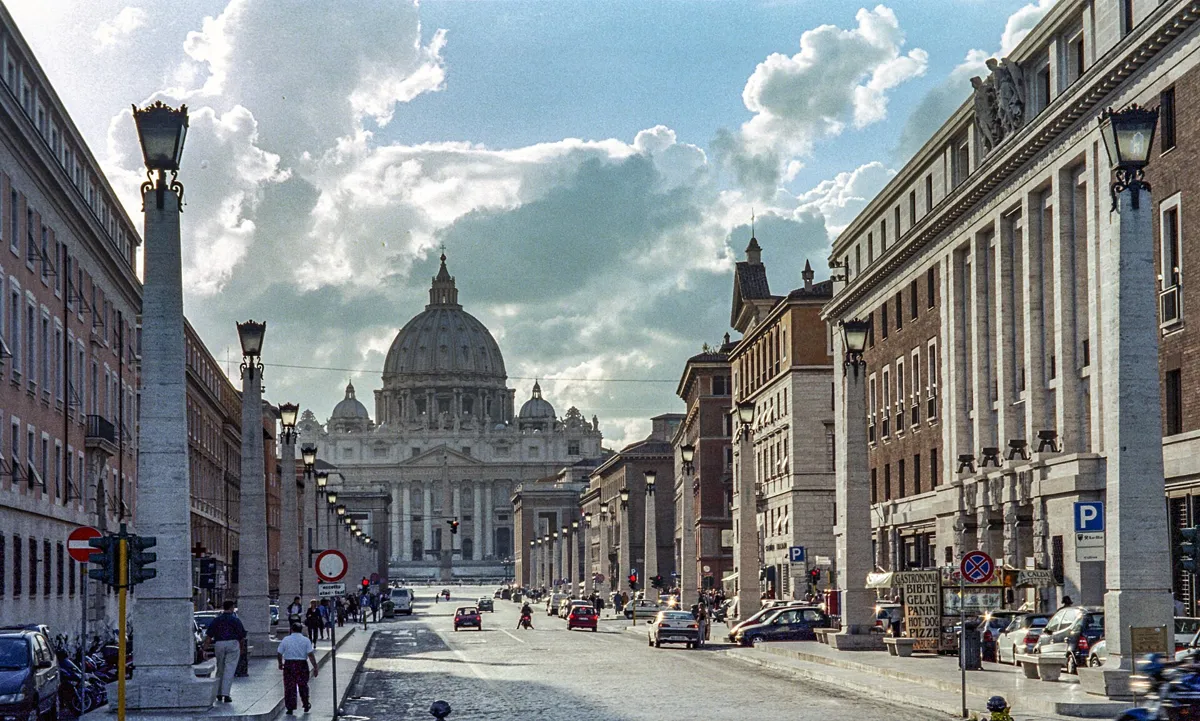
Via della Conciliazione, with St Peter's dome at the end. Photo: Jerzy Strzelecki, CC BY-SA 3.0, via Wikimedia Commons (resized). From the castle, follow Lungotevere Castello and then a path onto Via della Conciliazione. This wide avenue is only about 500 m long and is not old. It was built between 1936 and 1950 by pulling down the spina di Borgo, a block of buildings that stood between two older streets. Mussolini struck the first blow with a pickaxe in October 1936. The architects were Marcello Piacentini and Attilio Spaccarelli, and the street is named for the 1929 Lateran Treaty between Italy and the Holy See. The tall lamps shaped like obelisks went in for the Jubilee of 1950. It has long been criticised. Bernini had meant pilgrims to squeeze through narrow lanes and burst into the huge square. The avenue spoils that surprise, though you can still get it by entering the square from Borgo Santo Spirito.
More history
Many Borgo residents were moved out to the edge of the city. In 1948 and 1949, builders found the foundations of the Meta Romuli, a pyramid that Pope Alexander VI had demolished in 1499 to open a new street.
Sources: Wikipedia, Via della Conciliazione; Wikipedia (it), Via della Conciliazione; Wikipedia (it), Spina di Borgo; Wikipedia, St. Peter's Square.
-
St Peter's Square, Bernini's open arms
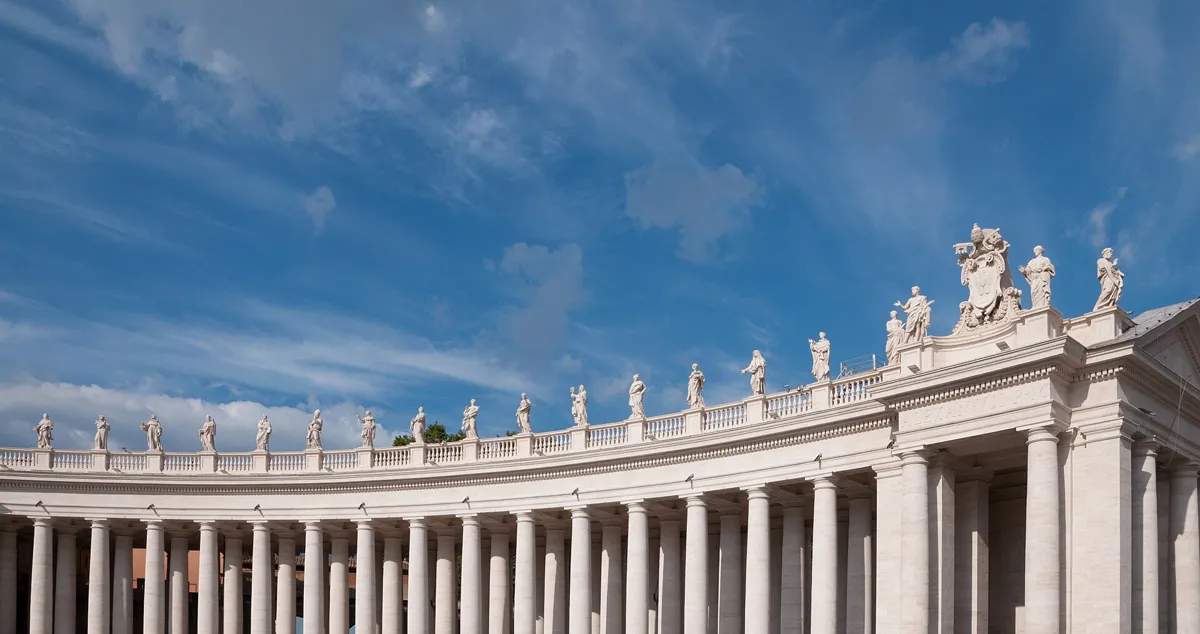
Bernini's north colonnade. Photo: MrPanyGoff (Plamen Agov), CC BY-SA 4.0, via Wikimedia Commons (resized). Keep on along Via della Conciliazione to Piazza Pio XII. A curved line of travertine in the paving marks the border: step over it and you are in Vatican City, with no passport check. Bernini designed the square for Pope Alexander VII, and the basilica's site dates its completion to 1667. The colonnades have 284 columns in four rows, with 140 statues on top. Two fountains stand in the square: Maderno's from 1613, and Bernini's matching one from 1675. In the middle is an Egyptian red granite obelisk about 25 m tall. According to Pliny it came from Heliopolis; it spent time in Alexandria, and was brought to Rome by Caligula for the circus of Caligula and Nero. In 1586 Domenico Fontana moved it 260 m to this spot for Pope Sixtus V. It is the only ancient obelisk in Rome that has never fallen. Look down: stones set in 1817 mark where the obelisk's noon shadow falls as the sun enters each sign of the zodiac. The square is Vatican territory, but Italian police handle crowds here, so two police forces work side by side.
More history
Moving the obelisk took 800 men, 160 horses and 45 winches, and the job went so well that Fontana was then asked to move three smaller obelisks. A famous story says that as the ropes began to give way, a sailor, Benedetto Bresca, shouted "water on the ropes!" to save them.
Sources: Wikipedia, St. Peter's Square; Wikipedia, Vatican obelisk; Wikipedia (it), Piazza San Pietro; Wikipedia (it), Obelisco Vaticano; Basilica of St Peter, the Square; Wikipedia (it), Confine tra Città del Vaticano e Italia; Wikipedia, Vatican City.
-
St Peter's Basilica, free to enter
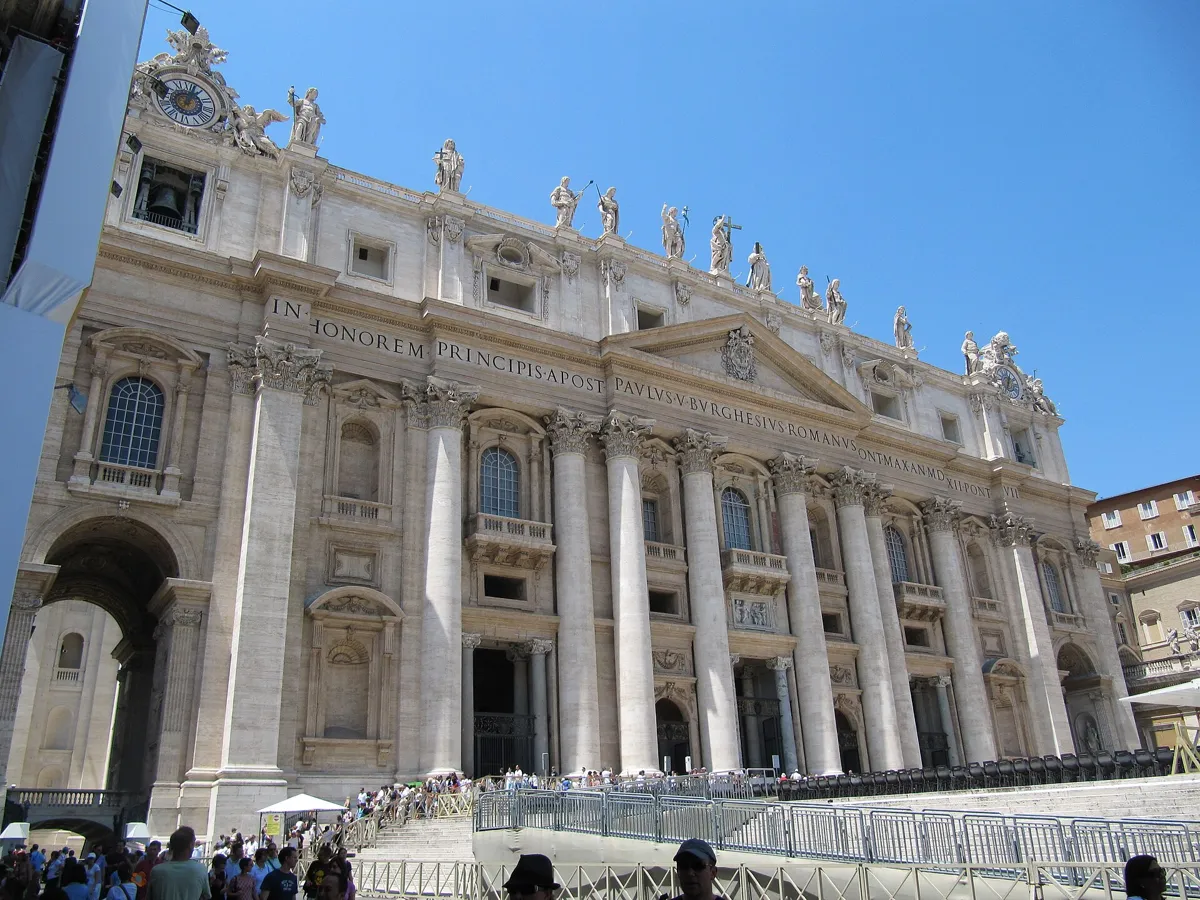
The front of the basilica. Photo: Palickap, CC BY-SA 4.0, via Wikimedia Commons (resized). Cross the square to the foot of the steps. The front you see is by Carlo Maderno, 114.69 m wide and 45.55 m high, with thirteen statues along the top: Christ, eleven apostles and John the Baptist. Peter's own statue stands beside the stairs. It is the second church on this spot: the first was Constantine's, begun in the 4th century. Pope Julius II decided in 1505 to replace it, and Bramante's foundation stone was laid in 1506. Michelangelo took over in 1547 and designed the dome. Maderno added the nave and front in the early 1600s. That nave now hides much of the dome from the square, so step back to see it. Tradition holds that St Peter is buried here. Entry is free, but you queue at a security check by the Italian State Police, in the right-hand colonnade as you face the basilica. Cover your knees and shoulders, and do not plan on phone calls, food or drink inside. There is no cloakroom, so carry only a small bag. The basilica's help page gives 7:00 to 20:00 all year, but hours can change on holidays and during major ceremonies, so check before you go.
More history
The old basilica was over 100 m long. Its demolition began on 18 February 1606 under Paul V, and Maderno's nave was started on 7 May 1607 with some 700 labourers. By interior measure it is the largest church in the world. The dome, the Treasury and the Necropolis under the nave need separate tickets, sold on the basilica's site.
Sources: Wikipedia, St. Peter's Basilica; Wikipedia (it), Basilica di San Pietro in Vaticano; Wikipedia, Vatican City; Basilica of St Peter, entering; Basilica of St Peter, visits and rules; Basilica of St Peter, opening hours; Basilica of St Peter, visitor FAQ (free entry, hours).
-
The Passetto di Borgo, the pope's escape corridor
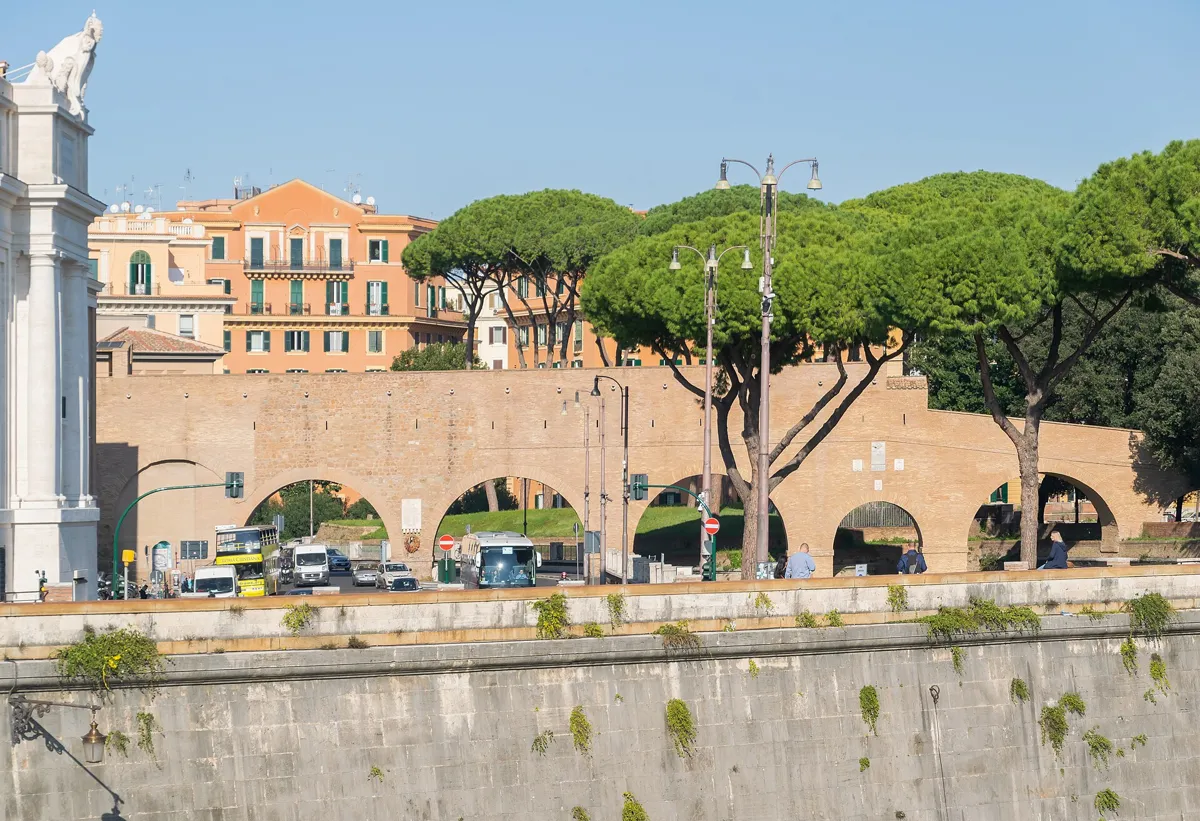
A stretch of the Passetto, seen from the Tiber embankment. Photo: Krzysztof Golik, CC BY-SA 4.0, via Wikimedia Commons (resized). Walk back to the colonnade on the left as you face the basilica, and leave by Largo del Colonnato to find the Passetto. It is a covered corridor about 800 m long, built inside an old city wall, that links the Vatican with Castel Sant'Angelo. The wall started with a defensive wall of about 547, during the Gothic War, and Leo IV rebuilt it around 852. Sources disagree on when the corridor was added: probably 1277 under Nicholas III, or in the 14th century. It has two levels: a patrol walk on top and a hidden passage below. Popes used it at least twice. Alexander VI crossed it in 1494 when the French king Charles VIII invaded, and Clement VII escaped through it in 1527 during the Sack of Rome. From here you see it only from outside.
More history
Pope Leo IV began the walls of his Leonine City on 27 June 852 by walking the line barefoot. Borgo became a district of Rome again in 1586.
Sources: Wikipedia, Passetto di Borgo; Wikipedia (it), Passetto di Borgo; Wikipedia (it), Mura leonine; Wikipedia (it), Borgo.
-
Porta Sant'Anna and the Swiss Guard
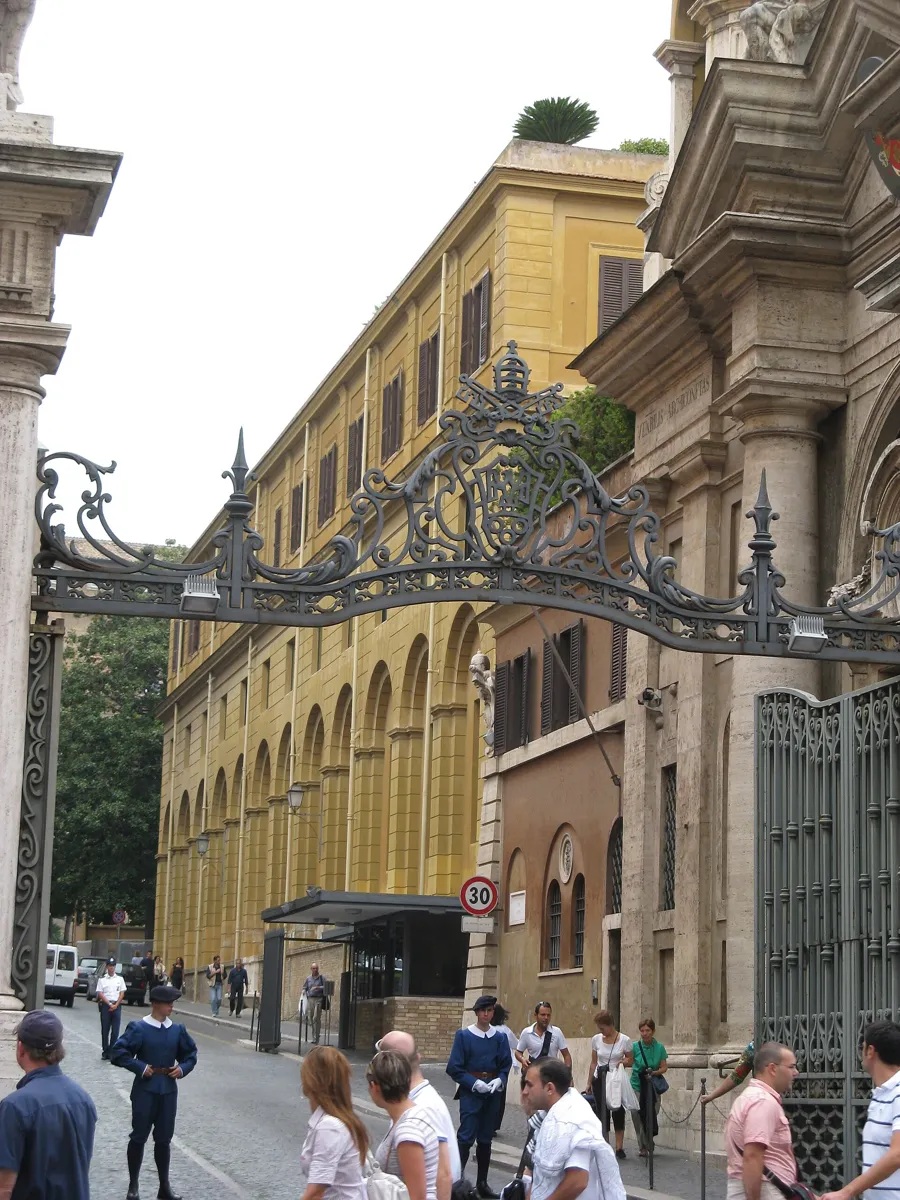
Porta Sant'Anna, with a guardsman at left. Photo: Yair Haklai, CC BY-SA 4.0, via Wikimedia Commons (resized). Walk up Via di Porta Angelica to the gate. Porta Sant'Anna is a border crossing between Italy and Vatican City, and the Swiss Guard controls it. The Guard was set up in 1506 under Julius II and is among the oldest military units in continuous operation. In 2024 it had 135 members. Recruits must be unmarried Swiss Catholic men aged 19 to 30 who have done Swiss army basic training. The striped Renaissance uniform is for ceremony. For everyday duty the guards wear plainer, functional clothes, as in the photo.
More history
The Guard's most significant battle was on 6 May 1527, in the Sack of Rome. Of 189 guards, 147 died so that Clement VII could escape through the Passetto. New guards are sworn in every year on 6 May to mark it.
Sources: Wikipedia, Swiss Guard; Wikipedia (it), Guardia svizzera pontificia; Wikipedia (it), Confine tra Città del Vaticano e Italia.
-
The Vatican walls and the Museums entrance
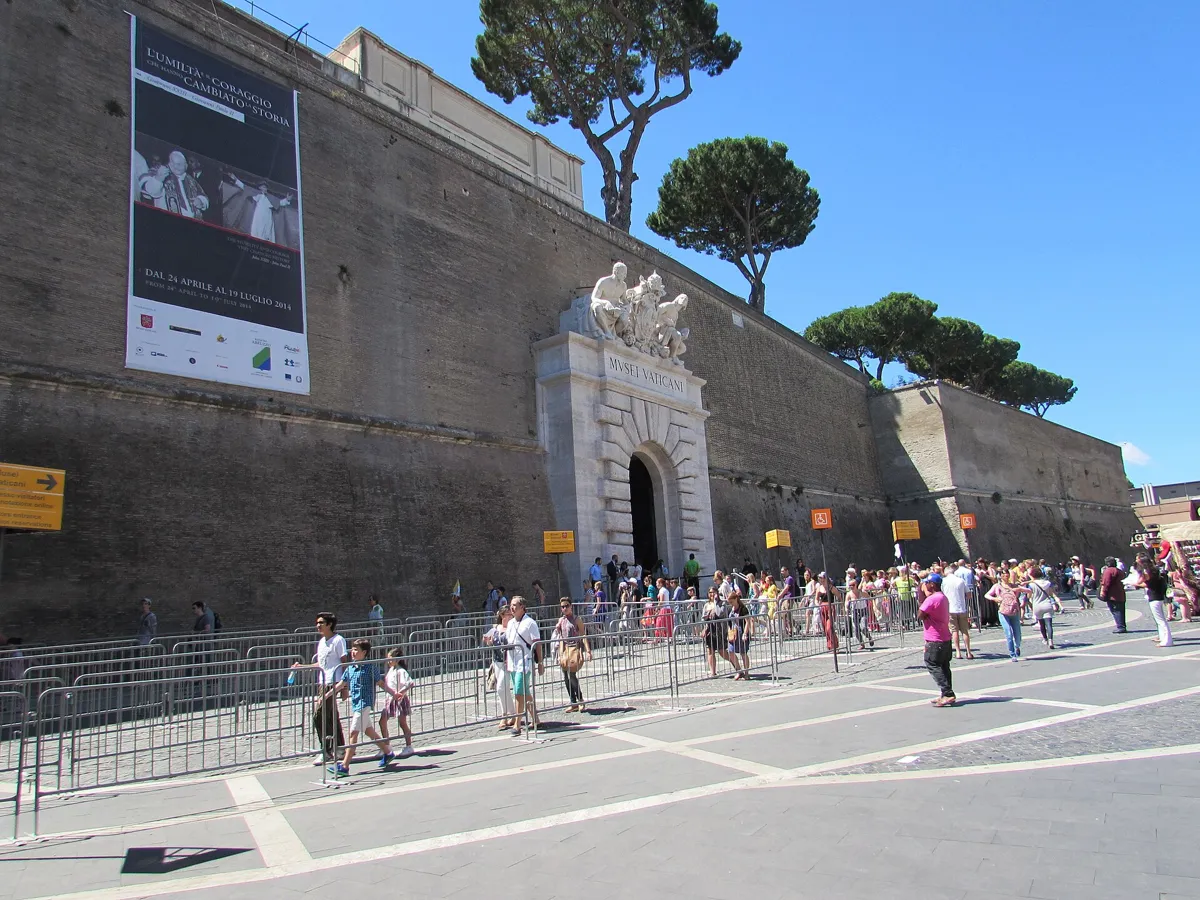
The Vatican Museums entrance in the wall. Photo: Cezar Suceveanu, CC BY-SA 4.0, via Wikimedia Commons (resized). Follow the wall on to Piazza del Risorgimento, then west along Viale Vaticano to the Museums entrance. From Piazza del Risorgimento westward, the state boundary is still the wall built under Paul III from 1543, on which Michelangelo and Sangallo worked. Behind it lie the Vatican Gardens, about half the state. The Museums began in 1506, when Julius II bought the Laocoon sculpture soon after it was found in a vineyard in Rome. In 2024 they had 6.8 million visitors, second only to the Louvre among art museums. The Sistine Chapel is the last room on the route. They are open Monday to Saturday, 8:00 to 20:00, last entry 18:00. On the last Sunday of the month they open 9:00 to 14:00, last entry 12:30, with free entry; other Sundays they are closed. The full ticket is €20 at the desk, and it is only valid on the day it is issued. Book through the official site (tickets.museivaticani.va), as look-alike sites can charge much more. Dress rules apply: no sleeveless or low-cut tops, shorts above the knee, miniskirts or hats.
More history
The Leonine Wall around Borgo was built between 848 and 852, using stone from Roman buildings. After the Sack of Rome, Paul III had the defences modernised, with sloping walls that stand up better to cannon fire.
Sources: Wikipedia, Vatican Museums; Wikipedia (it), Musei Vaticani; Wikipedia (it), Mura leonine; Wikipedia, Gardens of Vatican City; Vatican Museums, opening days and times; Vatican Museums, prices and tickets; Vatican Museums, useful advice.


Practical details
- Terrain
- Gentle: Open-Meteo puts the start at about 6 m and the Museums wall at about 33 m above sea level, a rise of under 30 m over 2.5 km. City elevation data can include buildings, so treat these as approximate. Wide pavements, but the squares are crowded.
- Step-free
- OpenStreetMap maps a flight of 22 steps at the foot of the basilica front. The basilica's site has a page on services for visitors with disabilities. Of the stops near the finish, OpenStreetMap lists the Risorgimento/S. Pietro tram stop as not wheelchair accessible.
- Water
- OpenStreetMap lists drinking fountains in St Peter's Square and on Via della Conciliazione (free, wheelchair accessible), and by the Museums wall.
- Toilets
- OpenStreetMap shows free public toilets near the basilica and near the Museums entrance, and a paid one at Castel Sant'Angelo. Check they are open.
- Sit and eat
- Cafes and snack bars are easy to find in the streets around St Peter's Square. Bring a small bag: the basilica has no cloakroom.
- When to go
- Castel Sant'Angelo is open Tuesday to Sunday, 9:00 to 19:30 (last entry 18:30), and closed on Mondays (apart from the first-Monday afternoon opening through 2026), 25 December and 1 January. The Vatican Museums are open Monday to Saturday, 8:00 to 20:00 (last entry 18:00), and on the last Sunday of the month, 9:00 to 14:00 (last entry 12:30), free. The basilica is listed as open 7:00 to 20:00 all year, with changes on holidays and during major ceremonies.
- Shorter walk
- Finish at stop 5, the basilica: 1.3 km, about 45 minutes. Then head back along Via della Conciliazione to the bridge.
- Getting back
- OpenStreetMap shows a station about 200 m from the finish, unnamed in its data, and the Risorgimento/S. Pietro tram stop about 380 m away. A stop called Sant'Angelo lies about 160 m from the start; the data does not say which lines serve it.
Walking distances and times from the OSRM foot router on OpenStreetMap data. Elevations from Open-Meteo. Stations, fountains, toilets and steps from OpenStreetMap; hours and prices from the Direzione Musei statali di Roma, the Vatican Museums and the Basilica of St Peter. Checked 5 October 2026.
Questions people ask
Is there a self-guided walking tour of the Vatican with a map?
Yes, this one. It is 2.5 km with eight stops and takes about 75 minutes: 33 minutes of walking plus time at each stop. It runs from Castel Sant'Angelo along Via della Conciliazione to St Peter's Square and the basilica, then past the Passetto and the Swiss Guard to the Vatican Museums entrance. The map is on this page, and you can print it or save it as a PDF.
Can you walk to Vatican City from Rome, and how long is the walk from Castel Sant'Angelo to St Peter's?
Yes. There are no passport controls for visitors entering Vatican City from Rome. From Castel Sant'Angelo it is about 880 m to St Peter's Square, around 12 minutes, and about 1.1 km, around 15 minutes, to the foot of the basilica steps. The route goes along Via della Conciliazione, which was built between 1936 and 1950.
Can you walk into Vatican City and St Peter's Basilica without a ticket, and what should you wear?
Yes. Public access to St Peter's Square and the basilica is free. You pass a security check by the Italian State Police first. Inside, cover your knees and shoulders, and do not make phone calls or eat or drink. There is no cloakroom, so bring only a small bag. The dome, Treasury and Necropolis, and the Vatican Museums, need tickets.
How long does it take to walk around Vatican City, and can you walk through the Vatican Gardens?
The border is 3.2 km long and the state covers 44 hectares, but you cannot walk all of it: much of the boundary is wall, and the gardens, about half the state, can only be visited with a guide. This walk follows the outside of the state from the square to the Museums wall.
When are the Vatican Museums free?
On the last Sunday of each month, from 9:00 to 14:00 with last entry at 12:30, subject to the museums' calendar of openings and closures. On other Sundays they are closed. From Monday to Saturday they open 8:00 to 20:00, with last entry at 18:00, and the full ticket was 20 euros when we checked.
Walk it with Strolio
Open Strolio at Ponte Sant'Angelo and ask for an hour around the Vatican. Strolio builds walks in any city with mapped streets, so its route may pick different stops from this page. Stories play as you reach each place, and you can ask about anything else you pass, by voice or with a photo. You can also start from your hotel and choose your own time and interests.
More walks in Rome
- The historic centre: ~70 min, 7 stops. From the square where Giordano Bruno was burned, past the Pantheon and Bernini's elephant, to the Trevi Fountain and the Spanish Steps.
- Ancient Rome: ~90 min, 8 stops. Round the Colosseum, past Trajan's Column, up Michelangelo's Capitoline to a free view over the Forum.
- The Jewish Ghetto and Trastevere: ~80 min, 8 stops. The Jewish Ghetto, over a Roman bridge of 62 BC to Trastevere and Raphael's Galatea.
- All Rome walks, with maps side by side.
- Walks in other cities.
Sources
- Ministero della Cultura, Direzione Musei statali di Roma: Museo Nazionale di Castel Sant'Angelo, for hours and tickets
- Basilica of St Peter (Fabbrica di San Pietro): the Square, entering, visits and rules, opening hours, visitor FAQ
- Vatican Museums: opening days and times, prices and tickets, useful advice
- Wikipedia (Italian): Ponte Sant'Angelo, Castel Sant'Angelo, Via della Conciliazione, Spina di Borgo, Piazza San Pietro, Obelisco Vaticano, Confine tra Città del Vaticano e Italia, Basilica di San Pietro in Vaticano, Passetto di Borgo, Mura leonine, Borgo, Guardia svizzera pontificia, Musei Vaticani
- Wikipedia (English): Ponte Sant'Angelo, Castel Sant'Angelo, Via della Conciliazione, St. Peter's Square, Vatican obelisk, St. Peter's Basilica, Passetto di Borgo, Swiss Guard, Vatican Museums, Gardens of Vatican City, Vatican City
- Map data and places: © OpenStreetMap contributors, ODbL; walking route from the OSRM foot router at routing.openstreetmap.de
- Elevations: Open-Meteo
- Photos: Wikimedia Commons contributors Sonse, AngMoKio, Jerzy Strzelecki, MrPanyGoff (Plamen Agov), Palickap, Krzysztof Golik, Yair Haklai and Cezar Suceveanu, credited under each photo