
Montmartre self-guided walking tour · 75 minutes · map
Montmartre on foot: windmills, painters' studios and Sacré-Cœur
Montmartre is the hill on the north side of Paris where the cabarets sat at the bottom and the painters lived at the top. This 75-minute walk climbs from the Moulin Rouge past Picasso's old studio, two windmills, a vineyard and a cabaret to the square of painters, the old village church and Sacré-Cœur.
The hill is 130 m high, the highest natural ground in Paris. Montmartre was a separate village of millers, wine growers and gypsum quarries until Paris annexed it on 1 January 1860. In the late 19th and early 20th centuries it drew artists with cheap rents, among them Renoir, Toulouse-Lautrec, Van Gogh, Picasso, Modigliani and Utrillo. The walk is uphill almost all the way, so take it slowly.
A note on accuracy: several places here are rebuilt or moved. Where a building is not the original, we say so, and every fact links to its source.
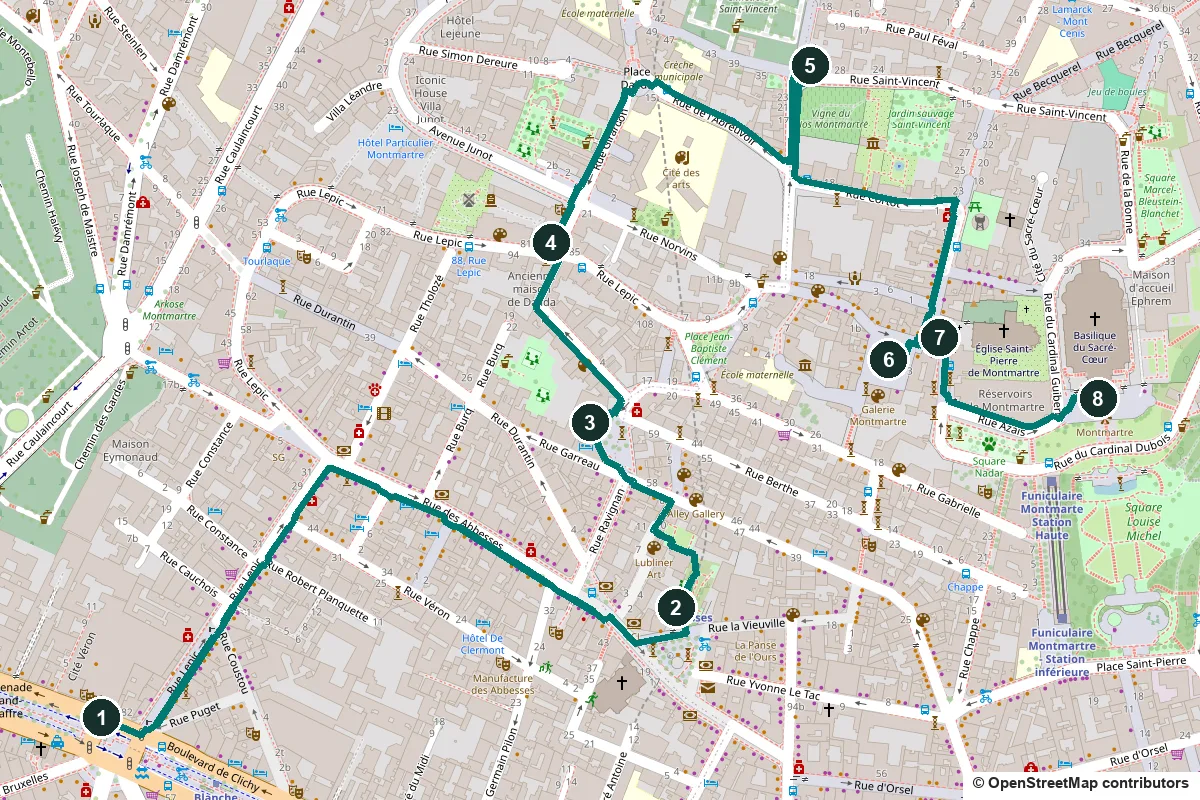
- Start
- The Moulin Rouge, Place Blanche, at Blanche metro (line 2)
- Finish
- Sacré-Cœur, beside the top station of the Montmartre funicular
- Distance
- 2 km, one way, about 80 m of climbing in all
- Time
- About 75 minutes: 27 min walking and 8 stops, plus any visit inside Sacré-Cœur
Terrain, stairs, water, opening hours and a shorter version ↓
What to see: the stops
-
The Moulin Rouge, a windmill built as a sign
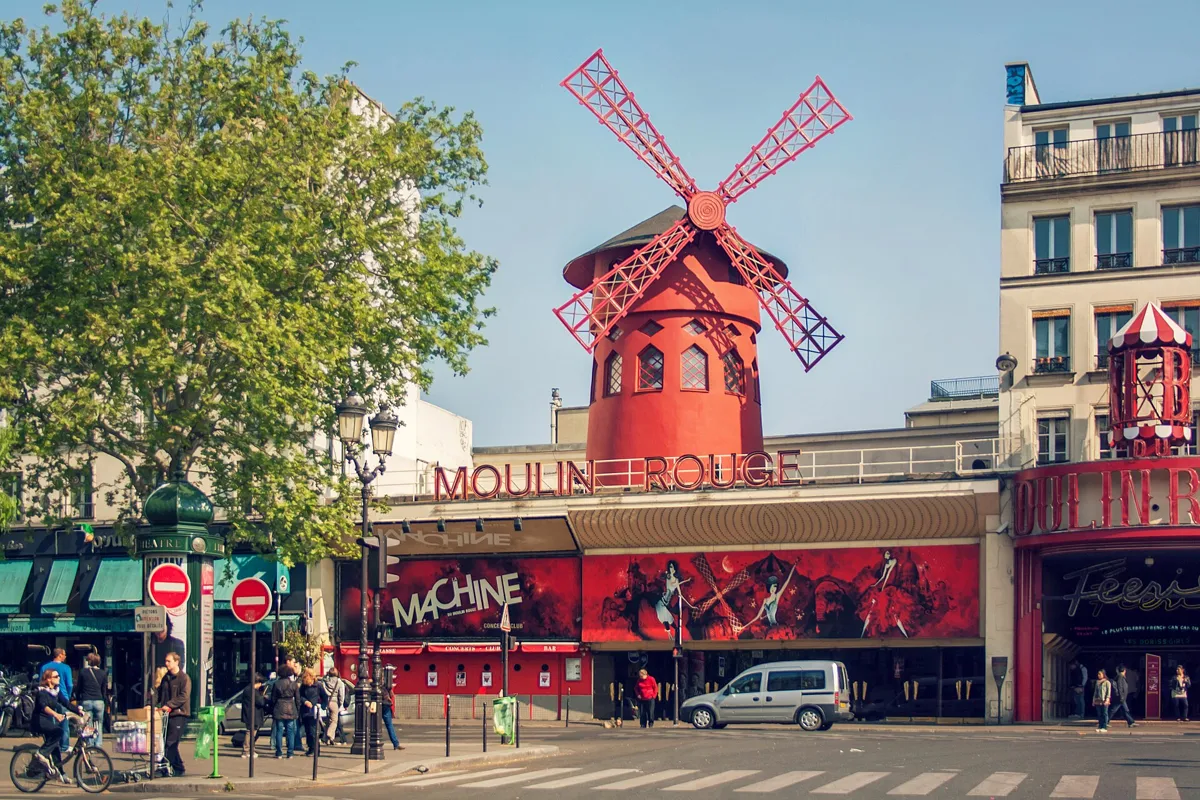
The Moulin Rouge from boulevard de Clichy. Photo: Juanedc from Zaragoza, España, CC BY 2.0, via Wikimedia Commons (resized). Leave Blanche metro onto boulevard de Clichy; the cabaret is at number 82. Joseph Oller and Charles Zidler, who also owned the Olympia, opened it on 6 October 1889 at the foot of the hill, on the site of an older dance hall, the Bal de la Reine Blanche. The red windmill was never a mill: it was a sign, lit at night so it could be seen from the boulevards, and designed by the artist Adolphe Willette. The dancer La Goulue became the face of its cancan, and Toulouse-Lautrec's posters made it famous; his first, in 1891, showed her. The original building burned on 27 February 1915 and reopened, rebuilt, in 1925. In the early hours of 25 April 2024 the sails fell into the street, without hurting anyone. They were back by 5 July, in time for the Olympic torch relay.
More history
In its first years the garden had a giant stucco elephant from the 1889 World's Fair. On 26 October 1890 the Prince of Wales, the future Edward VII, booked a table to see the quadrille; La Goulue spotted him and shouted that he could pay for the champagne.
Sources: Wikipedia (fr), Moulin-Rouge; Wikipedia, Moulin Rouge.
-
Place des Abbesses: a Guimard métro entrance and the "I love you" wall
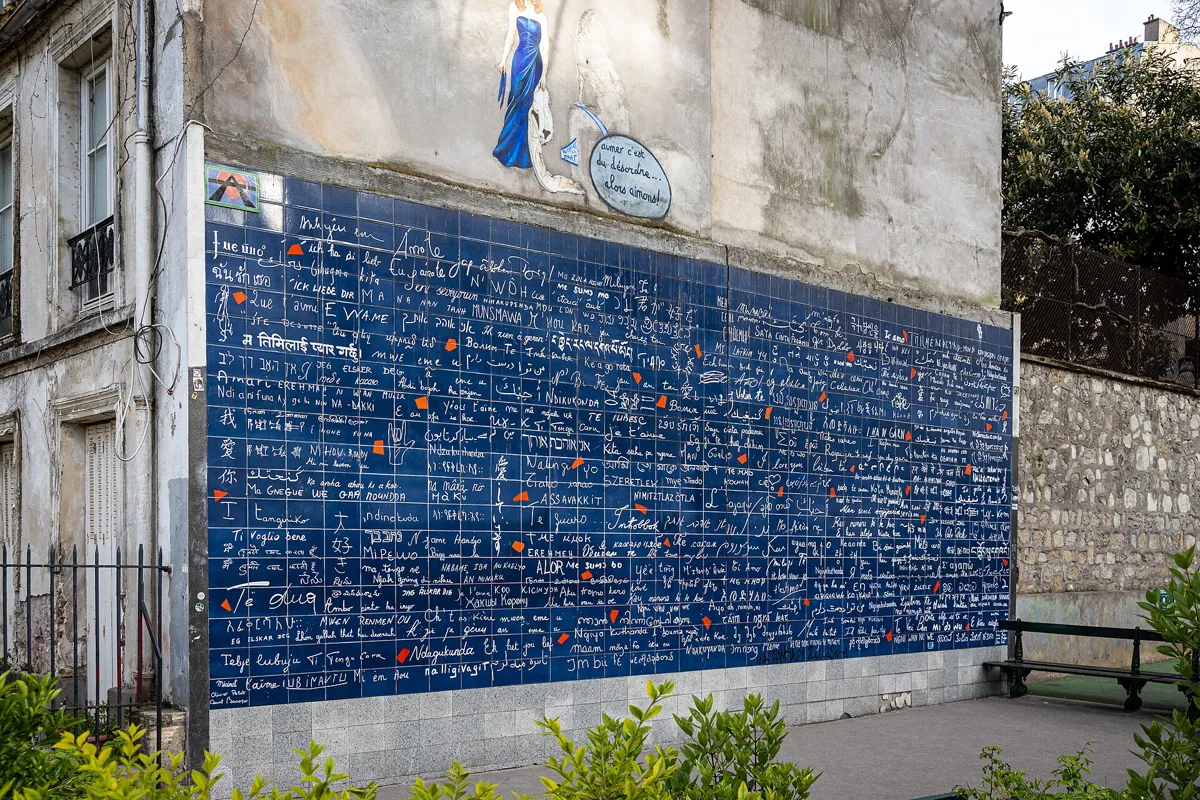
The Mur des je t'aime in Square Jehan-Rictus. Photo: Superbass, CC BY-SA 4.0, via Wikimedia Commons (resized). Walk up rue Lepic, a cobbled street made after Napoleon struggled up the hill in 1809. At number 15, on the corner of rue Cauchois, the Café des 2 Moulins is where Amélie works as a waitress in the 2001 film. Turn right along rue des Abbesses to the square, named after the abbesses of the Benedictine abbey on the hill. The métro entrance, with its glass canopy, is by Hector Guimard and dates from 1900, but it is not from here: it stood at Hôtel de Ville and was moved in 1974. Guimard never designed entrances for this line. Below it, the platforms are 36 m down, the deepest station inside Paris. On the north side, Square Jehan-Rictus was laid out in 1936 where Montmartre's town hall stood from 1837. In 2000 Frédéric Baron and Claire Kito put up the Mur des je t'aime here: 612 enamelled lava tiles carrying "I love you" 311 times in 250 languages. The red splashes are pieces of a broken heart. In October 2026 the City of Paris says the wall is closed for safety reasons.
More history
Baron began by asking his brother, then neighbours and passers-by, to write the words in their own language. The wall drew bigger crowds after it appeared in Emily in Paris in 2021, and it was cleaned of visitors' scribbled names in spring 2024, before the Olympics.
Sources: Wikipedia (fr), Place des Abbesses; Wikipedia (fr), Abbesses (métro); Mérimée heritage record, Abbesses entrance; Wikipedia (fr), Square Jehan-Rictus; Wikipedia (fr), Mur des je t'aime; Le mur des je t'aime; Wikipedia (fr), Rue Lepic; Wikipedia (fr), Café des 2 Moulins. Opening: paris.fr, Square Jehan-Rictus.
-
The Bateau-Lavoir, where Picasso painted Les Demoiselles d'Avignon
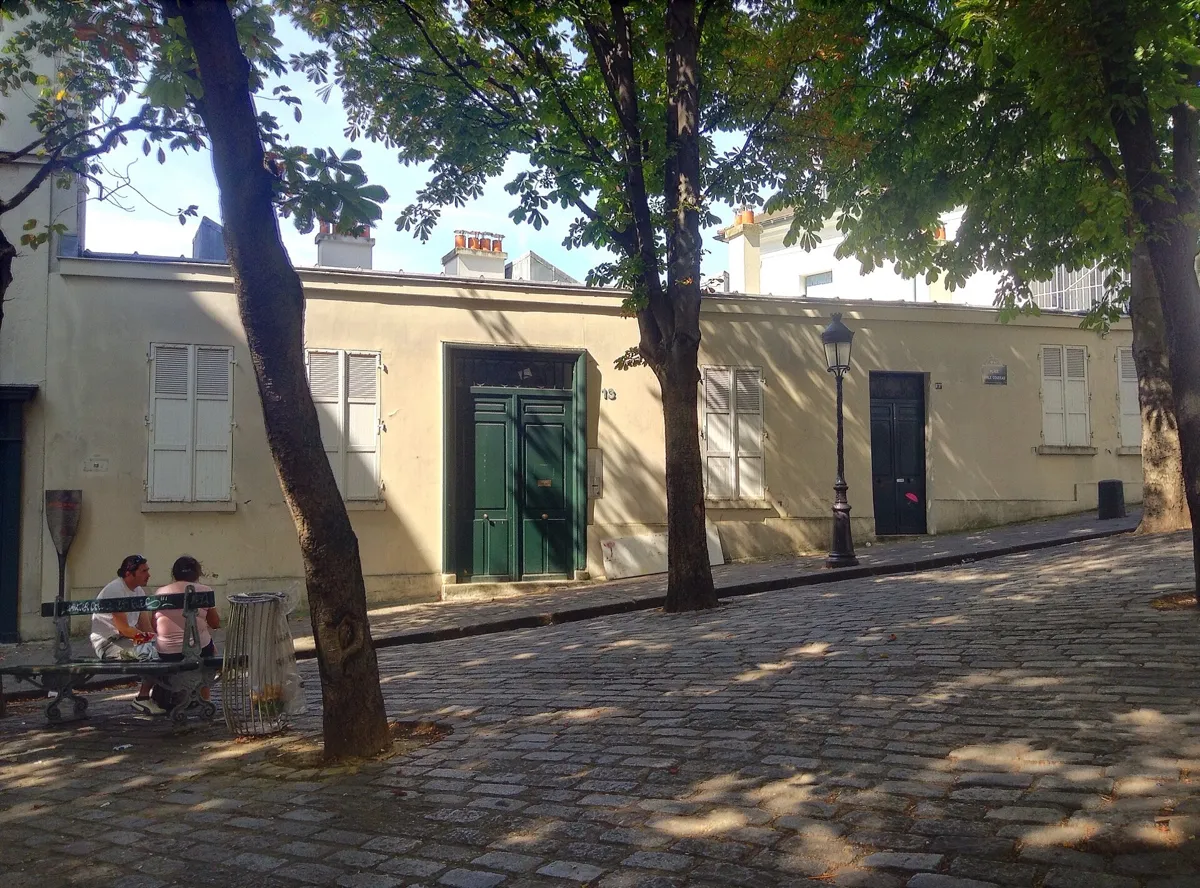
The front on Place Émile-Goudeau, a 1978 recreation. Photo: Kalashni, CC BY-SA 4.0, via Wikimedia Commons (resized). Climb the stairs of passage des Abbesses from the square, turn left along rue des Trois-Frères and go up rue Ravignan into Place Émile-Goudeau. Number 13, the low building on the slope, is the Bateau-Lavoir. It was a piano factory before it was turned into artists' studios in 1889. The rooms were divided by thin boards along a corridor, and 25 tenants shared one water tap. The poet Max Jacob is credited with the name, "wash-house boat". Picasso arrived in 1904 and lived here until 1909, painting Les Demoiselles d'Avignon here in 1907. Juan Gris, Van Dongen and Modigliani lived here too. What you see is not the old house: a fire gutted it on 12 May 1970, and in 1978 it was rebuilt in concrete with a recreated front and 25 studios behind.
More history
In 1908 the house threw a famous banquet for the painter Henri Rousseau. The square was called Place Ravignan until 1911, and it still has its Wallace fountain.
Sources: Mérimée heritage record, Bateau-Lavoir; Wikipedia (fr), Bateau-Lavoir; Wikipedia, Bateau-Lavoir; Wikipedia (fr), Place Émile-Goudeau.
-
The Moulin de la Galette, the last two windmills
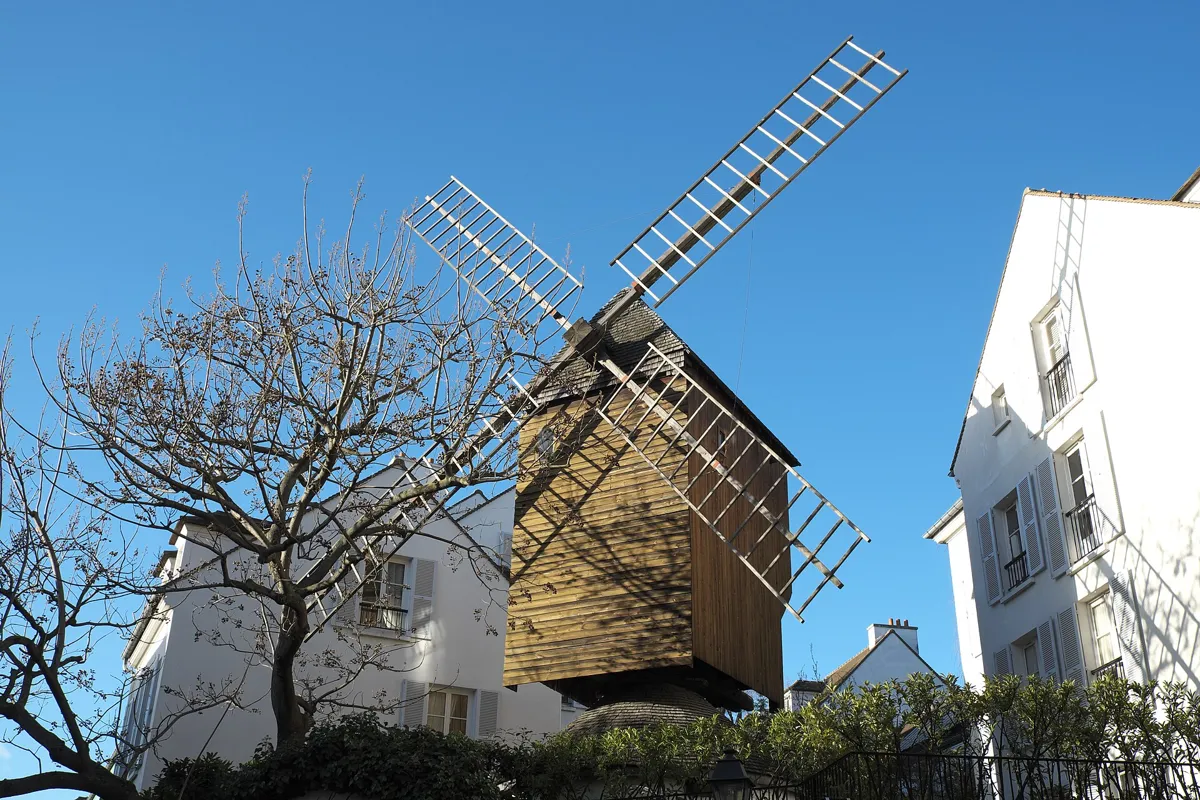
The Moulin Radet at the corner of rue Lepic and rue Girardon. Photo: GFreihalter, CC BY-SA 3.0, via Wikimedia Commons (resized). Walk up rue Ravignan and turn left into rue d'Orchampt, where the singer Dalida lived. It brings you out on rue Lepic, right at the corner of rue Girardon. "Moulin de la Galette" covers two windmills. The one above you is the Radet. It has been moved more than once: the Friends of Old Montmartre saved it from demolition in 1915, and in 1924 it was emptied of its machinery and set on the roof of a restaurant on this corner. The other, the Blute-Fin, stands a short way west at 75–77 rue Lepic, in private grounds you cannot visit. The Debray family of millers bought both in 1809 and 1812. They sold a small rye bread, the galette, with a glass of milk, and from 1833 ran a dance hall between the mills. Renoir painted it in 1876 as the Bal du moulin de la Galette.
More history
The Blute-Fin and its grounds have been a listed monument since 1958. The dance hall later became a music hall, then a studio for radio and television until 1974.
Sources: Mérimée heritage record, Moulin de la Galette; Wikipedia (fr), Moulin de la Galette; Wikipedia, Moulin de la Galette; Wikipedia (fr), Place Dalida.
-
The vineyard and the Lapin Agile cabaret
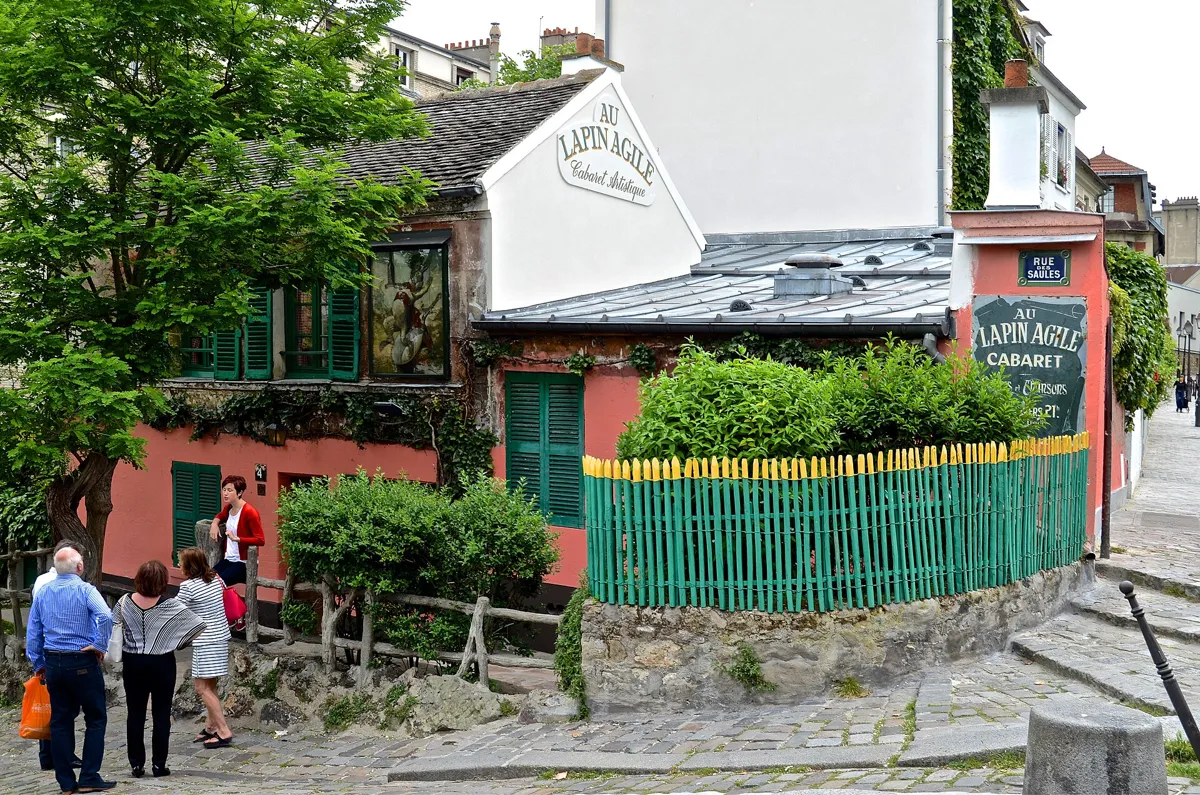
Au Lapin Agile, at the corner of rue des Saules and rue Saint-Vincent. Photo: David McSpadden from Daly City, United States, CC BY 2.0, via Wikimedia Commons (resized). Go up rue Girardon to Place Dalida, where a bronze bust of the singer was unveiled in 1997. Turn right down rue de l'Abreuvoir. On the corner of rue des Saules is the Maison Rose, a restaurant opened in 1908 by Germaine Pichot, a friend of Picasso; Utrillo painted it. Turn left down rue des Saules beside the Clos Montmartre. Vines once covered much of the hill, and the city replanted this one in the early 1930s. Today it has 1,762 vines of 27 kinds, mostly gamay. It makes about a tonne of grapes a year, pressed in the cellars of the 18th arrondissement's town hall. At the bottom stands the Lapin Agile, still a cabaret. It was the Cabaret des Assassins until about 1880, when the cartoonist André Gill painted a sign of a rabbit jumping out of a pan. People called it the lapin à Gill, Gill's rabbit, which became Lapin Agile, the nimble rabbit.
More history
In 1903 Frédéric Gérard, "Frédé", joined the cabaret; he kept a donkey called Lolo. In 1910 the writer Roland Dorgelès tied a brush to Lolo's tail and showed the result at the Salon des Indépendants as the work of an invented painter, Boronali. In 1905 Picasso painted Au Lapin Agile for Frédé; it sold for $40.7 million in 1989 and is now in the Metropolitan Museum in New York.
Sources: Wikipedia (fr), Au Lapin agile; Wikipedia, Au Lapin Agile (painting); paris.fr, Paris vineyards; Wikipedia (fr), Vigne de Montmartre; Wikipedia (fr), La Maison rose; Wikipedia (fr), Place Dalida.
-
Place du Tertre, the old village square
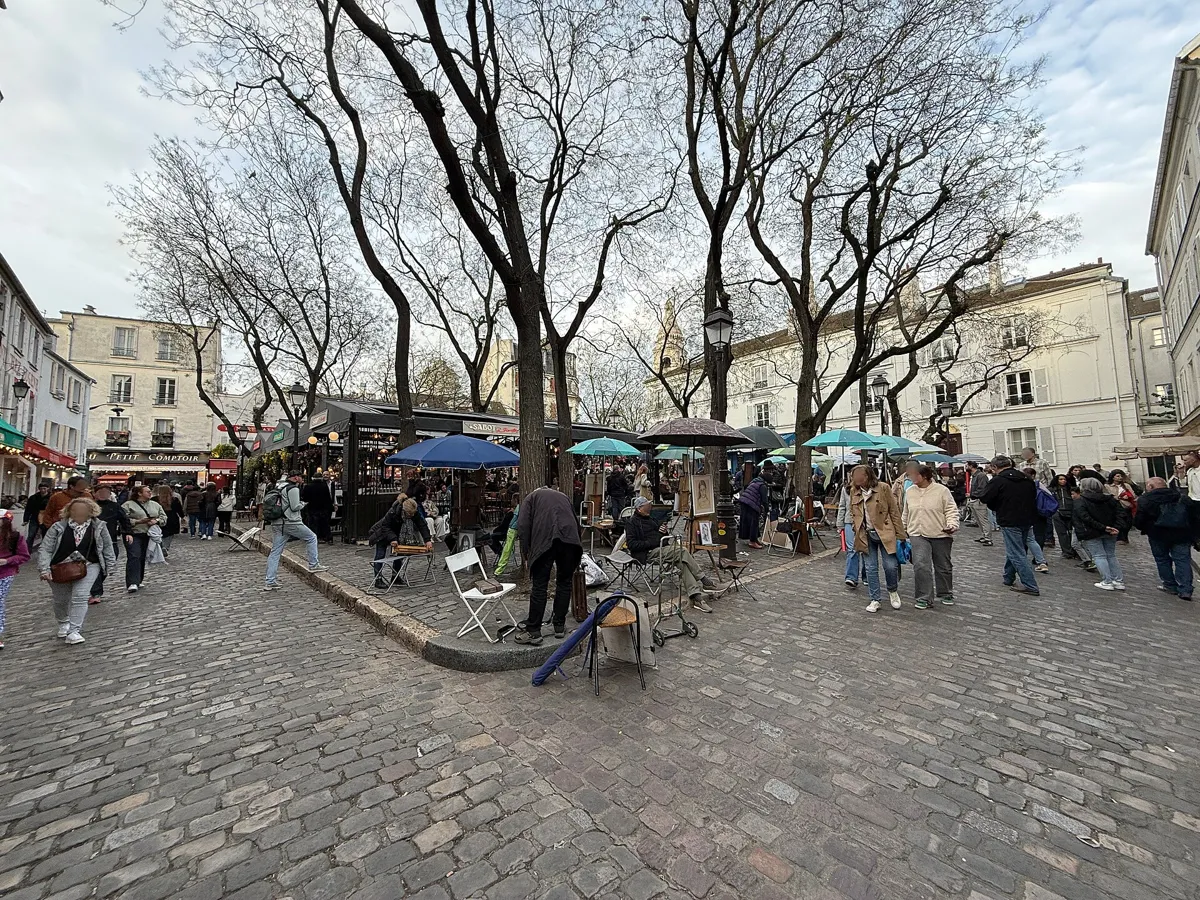
Place du Tertre in April 2026. Photo: Chabe01, CC BY-SA 4.0, via Wikimedia Commons (resized). Walk back up rue des Saules and turn left along rue Cortot. Number 12, on your left, is the Musée de Montmartre: Renoir rented a studio here in 1876 and painted the Bal du moulin de la Galette in it, and Suzanne Valadon and her son Maurice Utrillo lived here later. At the end, turn right up rue du Mont-Cenis to the square, at 130 m. Place du Tertre was the heart of the village. The abbey's nuns gave up this land in 1635, and from 1790 to 1860 it was the centre of the commune of Montmartre, whose first town hall was at number 3. Painters set up their easels here every day. In the 1990s the city divided their space into 140 pitches of one square metre each, and café terraces have taken much of the rest.
More history
A plaque at number 21 says that on 24 December 1898 Louis Renault drove his own car up to the square, the start of the French car industry.
Sources: Wikipedia (fr), Place du Tertre; Wikipedia, Place du Tertre; Wikipedia (fr), Musée de Montmartre. Visiting: Musée de Montmartre.
-
Saint-Pierre de Montmartre, one of the oldest churches in Paris
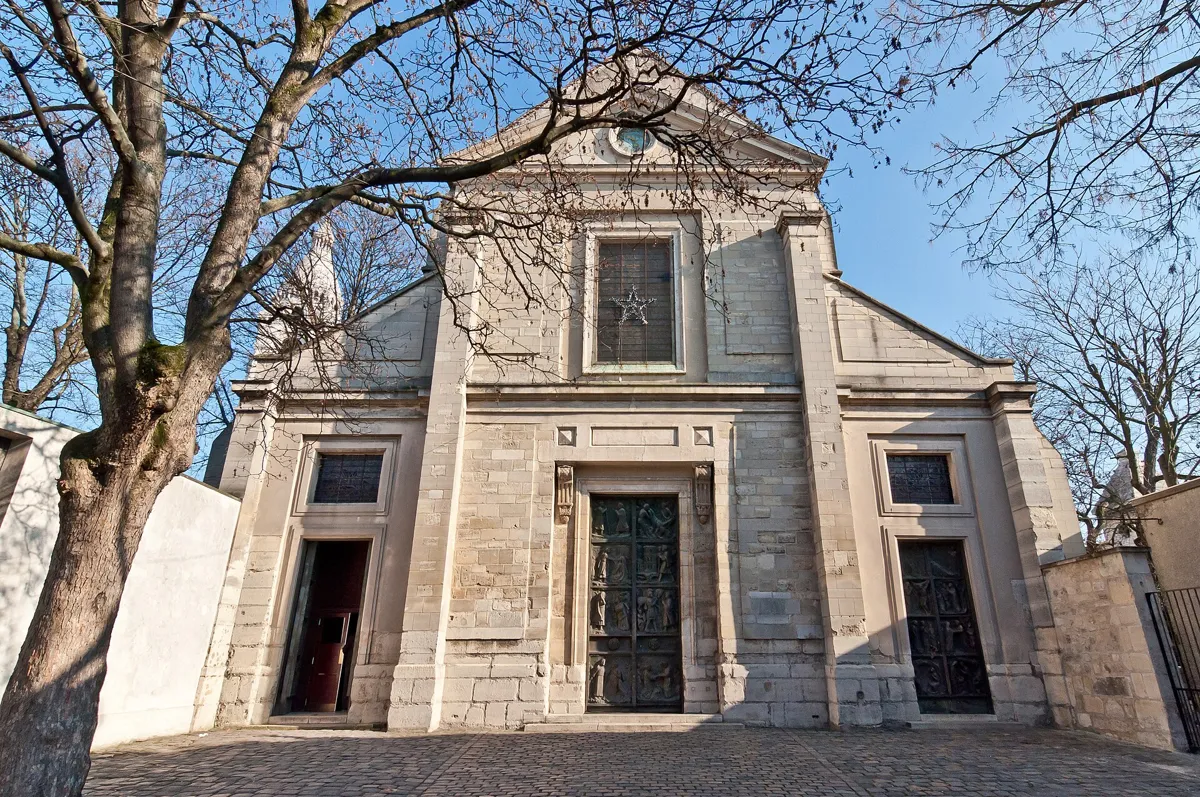
The west front on rue du Mont-Cenis. Photo: BastienM, CC BY-SA 3.0, via Wikimedia Commons (resized). From the east side of the square, take rue Norvins a few steps to rue du Mont-Cenis; the church front faces you. King Louis VI acquired the site in 1133, and he and Queen Adelaide founded a Benedictine abbey here; Pope Eugene III consecrated its church in 1147. It is the second-oldest parish church in Paris, after Saint-Germain-des-Prés. Inside, white marble capitals from an earlier, Merovingian church are reused on top of dark marble columns. The front itself dates from the 18th century. Its three bronze doors, showing St Denis, St Peter and the Virgin Mary, were given by the Italian sculptor Tommaso Gismondi in 1980. In 1794 a tower for Claude Chappe's signal telegraph was built over the choir; it came down in 1840. The church was closed as unsafe in 1896, restored in the early 1900s and listed in 1923. Beside it, the Calvaire cemetery holds the highest natural ground in Paris, 130.53 m.
More history
In 1686 the nuns moved down the hill, near today's Place des Abbesses. The abbey was closed in 1792, and the last abbess, Louise de Laval, was guillotined in 1794.
Sources: Wikipedia (fr), Église Saint-Pierre de Montmartre; Wikipedia, Saint-Pierre de Montmartre; Mérimée heritage record, Saint-Pierre; Wikipedia (fr), Montmartre.
-
Sacré-Cœur and the view over Paris
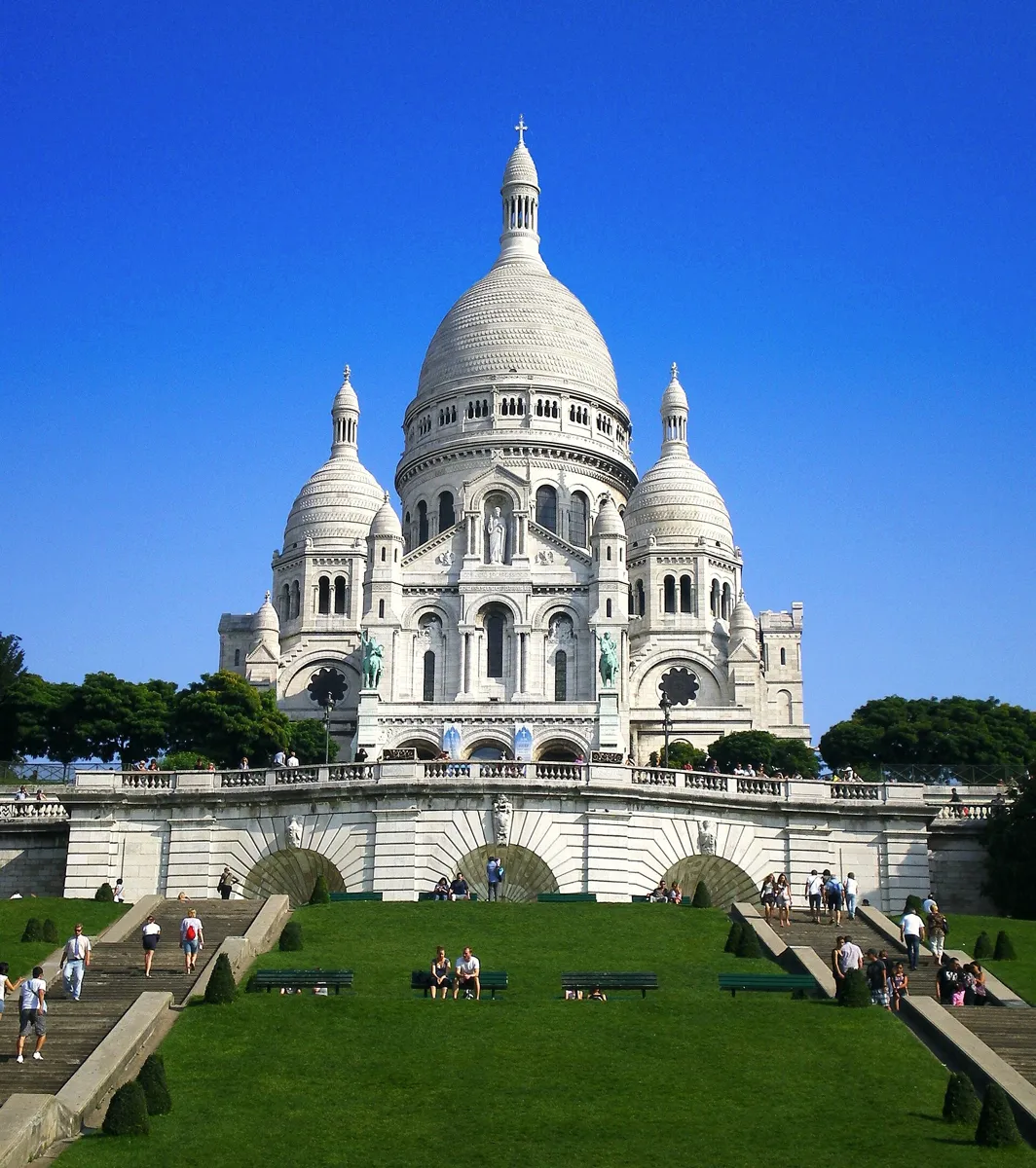
The south front from Square Louise-Michel. Photo: Tonchino, CC BY-SA 3.0, via Wikimedia Commons (resized). Follow rue du Mont-Cenis a few metres and turn left along rue Azaïs to the terrace in front of the basilica. Sacré-Cœur grew out of a vow made after France's defeat in the war of 1870. The National Assembly declared it of public use in 1873, and Paul Abadie won the design competition in 1874. The first stone was laid on 16 June 1875. Old gypsum quarries under the hill meant the foundations had to go down through 83 shafts, each 33 m deep. The white stone comes from Château-Landon and Souppes-sur-Loing and gives off calcite when wet, which keeps it white. The bell tower was finished in 1914, but the war delayed the consecration to 16 October 1919. The site is loaded: the Commune began on this hilltop on 18 March 1871, when soldiers tried to take away the cannon stored here. Some on the left still see the basilica as a symbol of the Commune's crushing. It was listed as a historic monument in December 2022.
More history
The dome rises to 83 m. The bell, the Savoyarde, weighs 18,835 kg and was cast in Annecy in 1895. The mosaic over the choir covers 473.78 m², the largest in France.
Sources: Mérimée heritage record, Sacré-Cœur; Wikipedia (fr), Basilique du Sacré-Cœur; Wikipedia, Sacré-Cœur; Wikipedia, Montmartre. Visiting: the basilica's site.


Practical details
- Terrain
- Uphill most of the way. Open-Meteo puts the Moulin Rouge at about 69 m above sea level, the windmill at 113 m and Sacré-Cœur at 133 m, with a dip to 98 m at the Lapin Agile. Rue Lepic averages about 7%. Cobbles on many streets.
- Stairs
- OpenStreetMap maps about 60 steps from the square up to rue des Trois-Frères: a flight of 10 out of the garden, then four flights on passage des Abbesses. There is a short flight at Place Émile-Goudeau and short flights onto the terrace at Sacré-Cœur. The basilica has a lift at the back, 35 rue du Chevalier-de-la-Barre, 8:30 to 18:30. Blanche and Abbesses stations are not step-free; OpenStreetMap marks the funicular stations as wheelchair accessible.
- Water
- OpenStreetMap lists drinking fountains on Place des Abbesses and Place Émile-Goudeau, and one about 70 m from Sacré-Cœur.
- Toilets
- A free public toilet, open 24 hours and wheelchair accessible, about 40 m from the Moulin Rouge, and a paying one, open 11:00 to 18:00, about 60 m from Sacré-Cœur. There are none at the dome.
- Sit and eat
- The Café des 2 Moulins (on the way to stop 2), the Maison Rose (stop 5) and the terraces round Place du Tertre (stop 6). The Musée de Montmartre has a garden café.
- Opening hours
- Sacré-Cœur: free, every day 6:30 to 22:30. Dome: 10:30 to 19:30, last entry 19:00, closed at midday and in bad weather; 8 euros, 280 steps. Musée de Montmartre: daily 10:00 to 18:00, 14 euros (16 during exhibitions). Square Jehan-Rictus from 1 to 24 October: 8:00 to 18:30 on weekdays, from 9:00 at weekends.
- Shorter walk
- Skip stop 5: from the windmill, follow rue Norvins straight to Place du Tertre, about 340 m. That cuts the walk to about 1.6 km.
- Getting back
- The funicular's top station is beside the basilica. It runs 108 m down to Place Saint-Pierre on a metro ticket, next to the 222 steps of rue Foyatier. Anvers metro (line 2) is about 400 m from the basilica as the crow flies.
Walking distances and times from the OSRM foot router on OpenStreetMap data. Elevations from Open-Meteo. Stairs, fountains, toilets and stations from OpenStreetMap; opening hours and prices from the basilica, the Musée de Montmartre and paris.fr. Checked 4 October 2026: check before you go.
Questions people ask
How long does it take to walk around Montmartre, and is there a map?
This walk takes about 75 minutes: 2 km, 27 minutes of walking and eight stops, from the Moulin Rouge at Blanche metro to Sacré-Cœur. Allow more if you go inside the basilica or climb its dome. The map is on this page, and you can print it or save it as a PDF.
Is Montmartre steep, and how do you avoid the stairs?
Yes. The walk climbs from about 69 m above sea level at the Moulin Rouge to about 133 m at Sacré-Cœur, and rue Lepic rises at about 7% on average. On this route the only long stairway is the climb from Square Jehan-Rictus up passage des Abbesses, about 60 steps; there are also short flights onto the terrace in front of Sacré-Cœur. To skip the last climb, the funicular runs from Place Saint-Pierre to the top, rising 36 m in under a minute and a half, on a metro ticket. The basilica has a lift at the back, at 35 rue du Chevalier-de-la-Barre, open 8:30 to 18:30.
Is Sacré-Cœur free to visit?
Yes. The basilica is free and open every day from 6:30 to 22:30. Between 10:30 and 17:00 you may wait 10 to 15 minutes to get in. The dome costs 8 euros for adults and 5 euros for children up to 15; it is 280 steps up a narrow stair with no lift. Check the basilica's website before you go.
What is Montmartre known for?
Montmartre is a 130 m hill in the 18th arrondissement, a separate village until Paris annexed it in 1860. It is known for its artists, from Renoir, who painted the Bal du moulin de la Galette in a studio on rue Cortot, to Picasso at the Bateau-Lavoir; for cabarets such as the Moulin Rouge and the Lapin Agile; for its windmills and its small vineyard; and for the white basilica of Sacré-Cœur on the top. The Paris Commune began here on 18 March 1871.
Can you visit the Mur des je t'aime?
It is in Square Jehan-Rictus on Place des Abbesses, a free public garden. In October 2026 the City of Paris says the wall is closed for safety reasons, so check the square's page on paris.fr before you go.
Walk it with Strolio
Open Strolio at Place Blanche and ask for 75 minutes up the hill of Montmartre. Strolio builds walks in any city with mapped streets, so its route may pick different stops from this page. Stories play as you reach each place, and you can ask about anything else you pass, by voice or with a photo. You can also start from your hotel and choose your own time and interests.
More walks in Paris
- Le Marais: ~80 min, 8 stops. From the medieval city wall and the Place des Vosges to the Jewish quarter on rue des Rosiers.
- The Latin Quarter: ~80 min, 8 stops. Roman baths, the Sorbonne and the Panthéon, from Place Saint-Michel to the Luxembourg Garden.
- Île de la Cité to the Louvre: ~80 min, 8 stops. Notre-Dame, the Conciergerie and Sainte-Chapelle, across the Pont Neuf to the Louvre courtyards and the Palais-Royal.
- All Paris walks, with maps side by side.
- Walks in other cities.
Sources
- Ministère de la Culture, POP, Mérimée heritage records: Abbesses métro entrance, Bateau-Lavoir, Moulin de la Galette, Saint-Pierre de Montmartre, Sacré-Cœur. We used their facts and wrote our own text.
- Ville de Paris: Square Jehan-Rictus, Paris vineyards
- Wikipedia (French): Montmartre, Moulin-Rouge, Rue Lepic, Café des 2 Moulins, Place des Abbesses, Abbesses (métro de Paris), Square Jehan-Rictus, Mur des je t'aime, Bateau-Lavoir, Place Émile-Goudeau, Moulin de la Galette, Place Dalida, La Maison rose, Vigne de Montmartre, Au Lapin agile, Musée de Montmartre, Place du Tertre, Église Saint-Pierre de Montmartre, Basilique du Sacré-Cœur de Montmartre, Funiculaire de Montmartre
- Wikipedia (English): Montmartre, Moulin Rouge, Bateau-Lavoir, Moulin de la Galette, Au Lapin Agile (painting), Place du Tertre, Saint-Pierre de Montmartre, Sacré-Cœur
- Opening times and visits: Sacré-Cœur, hours, Sacré-Cœur, dome, Musée de Montmartre, Le mur des je t'aime
- Map data and places: © OpenStreetMap contributors, ODbL; walking route from the OSRM foot router run by FOSSGIS
- Elevations: Open-Meteo
- Photos: Wikimedia Commons contributors Juanedc, Superbass, Kalashni, GFreihalter, David McSpadden, Chabe01, BastienM and Tonchino, credited under each photo