
Latin Quarter self-guided walking tour · 80 minutes · map
The Latin Quarter on foot: Roman baths, the Sorbonne and the Panthéon
The Latin Quarter is the old university district on the Left Bank of Paris. This 80-minute walk starts by the Seine at Place Saint-Michel and climbs past a famous bookshop, two medieval churches, Roman baths and the Sorbonne to the Panthéon, then drops down to the Luxembourg Garden.
The quarter covers the 5th and parts of the 6th arrondissement and stands on the site of the Roman town of Lutetia. King Philip Augustus recognised the University of Paris in 1200, and colleges filled the slopes of the Montagne Sainte-Geneviève. Teaching was in Latin, and students and teachers spoke it in and out of class until the Revolution, which is where the name comes from. From 1855 Haussmann cut the boulevards Saint-Michel and Saint-Germain through the old streets, and much of the medieval quarter went.
A note on accuracy: some buildings here were rebuilt or moved, and two stops charge for entry. Where a building is not the original, we say so, and every fact links to its source.
- Start
- Place Saint-Michel, at Saint-Michel metro (line 4) and Saint-Michel–Notre-Dame RER (B, C)
- Finish
- The Fontaine Médicis in the Luxembourg Garden, about 300 m from Luxembourg RER (B)
- Distance
- 2.9 km, one way, uphill to the Panthéon and down to the garden
- Time
- About 80 minutes: 39 min walking and 8 stops, plus any visit to the Musée de Cluny or the Panthéon
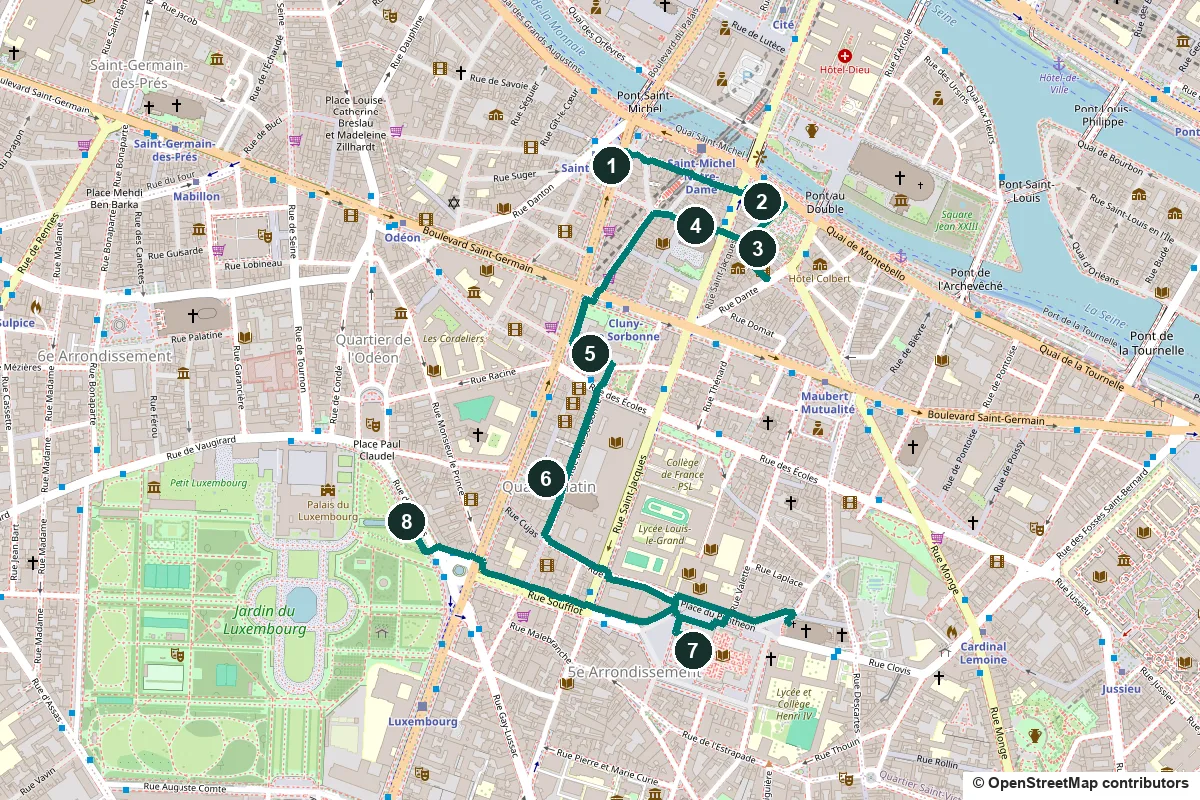
Terrain, steps, water, opening hours and a shorter version ↓
What to see: the stops
-
The Fontaine Saint-Michel, St Michael and the devil
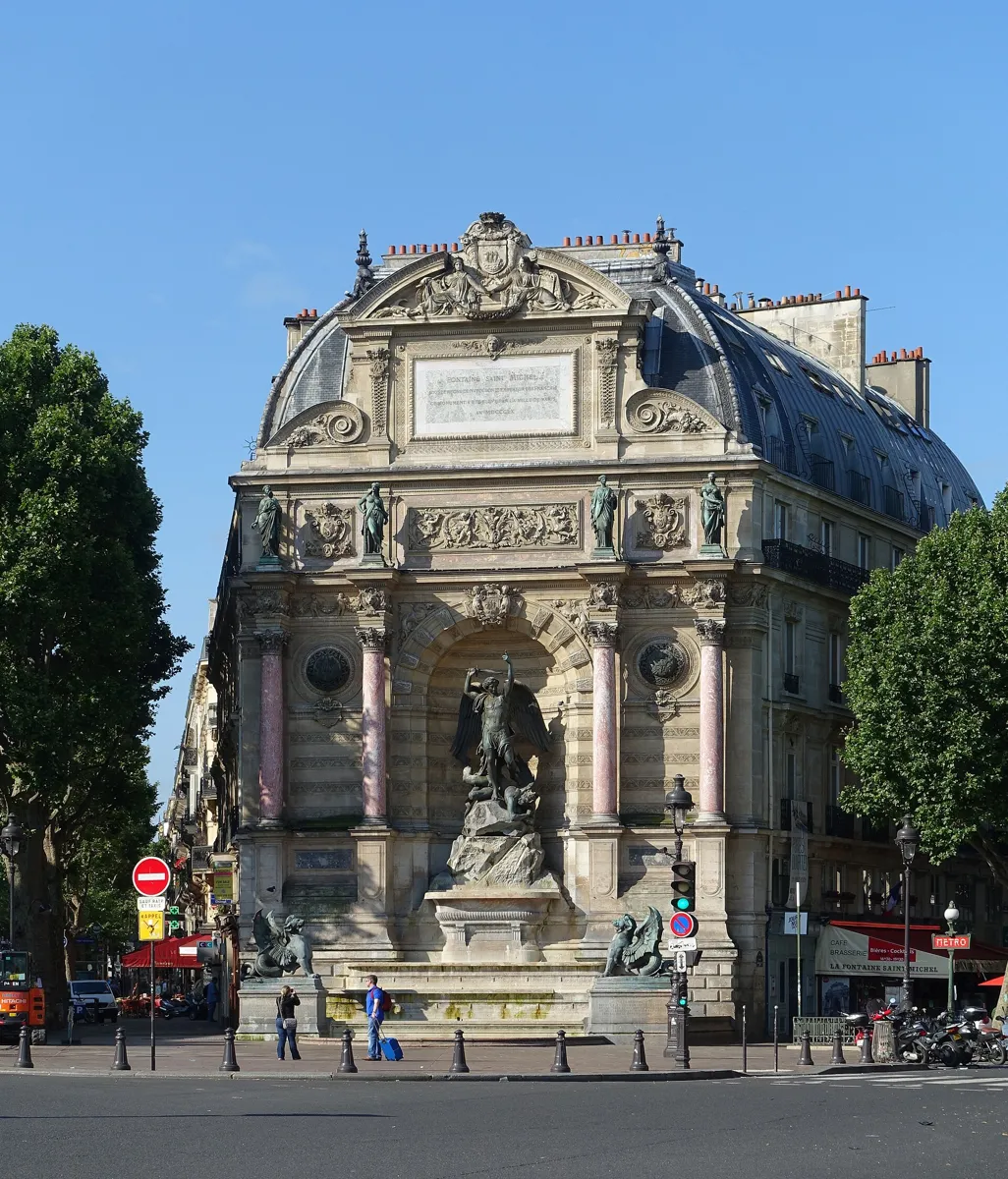
The fountain on Place Saint-Michel. Photo: Guilhem Vellut, CC BY 2.0, via Wikimedia Commons (resized). Come up from the metro onto Place Saint-Michel and face the fountain on the corner of boulevard Saint-Michel. The square was opened up in 1855, when Haussmann cut the new boulevard, and Gabriel Davioud designed the fountain, built from 1858 to 1860. The city asked him to hide the bare end wall of the building on the corner of rue Saint-André-des-Arts, and the fountain he designed looks like a triumphal arch, 26 m by 15 m. His first plans put Peace and then Napoleon in the central arch; opponents of Napoleon III protested so hard that the Archangel Michael, fighting the devil, took the place instead. The bronze is by Francisque-Joseph Duret, and two winged dragons spout water at the sides. Note the colours: red and green marble, blue and yellow stone. It was unveiled on 15 August 1860, and it was the last monumental wall fountain built in Paris.
More history
In August 1944, students in the Resistance fought German troops on this square. The lead eagles that once topped the fountain were destroyed around the time of the Commune in 1871.
Sources: Ministère de la Culture, Mérimée; Wikipedia, Fontaine Saint-Michel; Wikipedia (fr), Place Saint-Michel.
-
Shakespeare and Company, the bookshop that borrowed its name
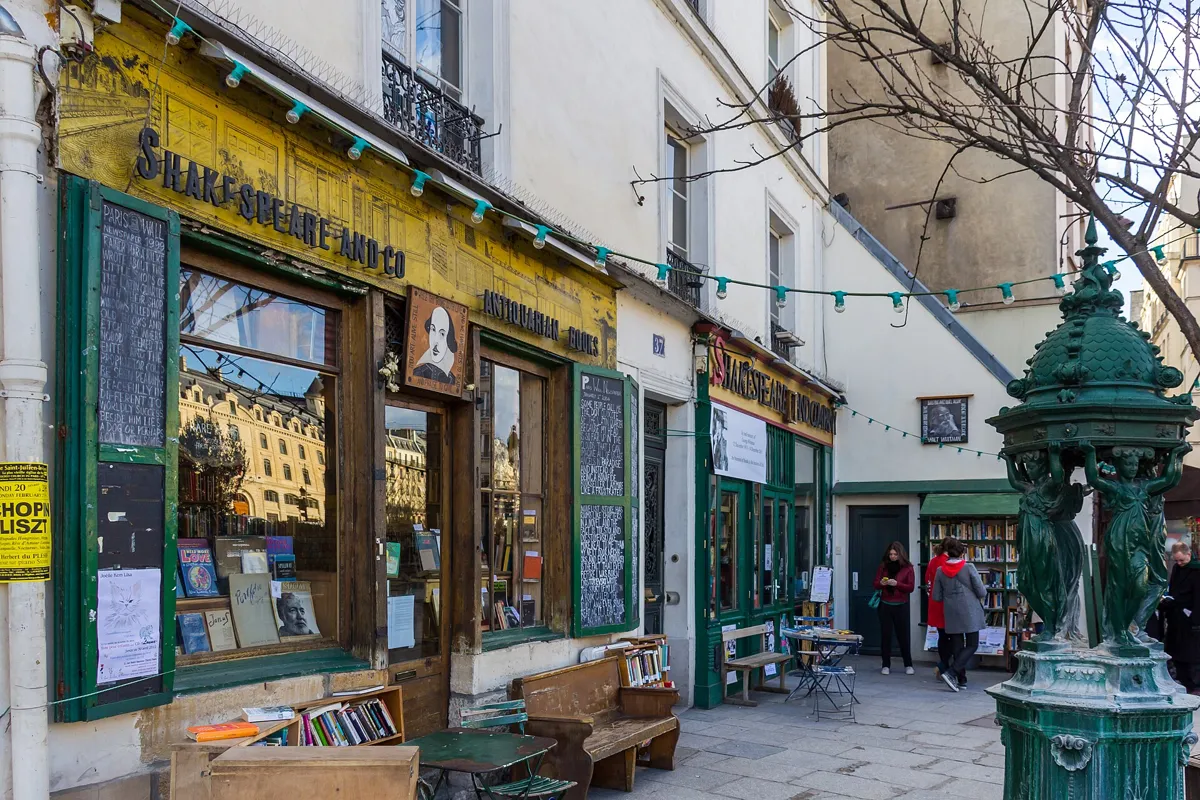
37 rue de la Bûcherie. Photo: Mike Peel, CC BY-SA 4.0, via Wikimedia Commons (resized). Cross to the east side of the square and walk along rue de la Huchette, a narrow street of restaurants. At number 23, the Théâtre de la Huchette has played Ionesco's The Bald Soprano and The Lesson without a break since 1957. At rue du Petit-Pont, cross into rue de la Bûcherie; the shop is at number 37, facing Notre-Dame. The American George Whitman opened it in 1951 as Le Mistral. In April 1964, on the 400th anniversary of Shakespeare's birth, he renamed it in honour of Sylvia Beach, a bookseller he admired, who had founded the original Shakespeare and Company in 1919. Her shop on rue de l'Odéon was a meeting place for Joyce, Hemingway and Pound, and in 1922 she published Joyce's Ulysses; it closed in 1941, under the German occupation. Whitman let young writers sleep among the shelves in return for reading a book a day, helping in the shop and writing a one-page life story; the shop puts their number at about 30,000. Over the library door is his motto: "Be not inhospitable to strangers lest they be angels in disguise."
More history
Early visitors included Allen Ginsberg, William Burroughs and James Baldwin. Whitman died in 2011, two days after his 98th birthday; his daughter Sylvia, named after Sylvia Beach, now runs the shop.
Sources: Shakespeare and Company, history; Wikipedia, Shakespeare and Company; Wikipedia (fr), Shakespeare and Company; Wikipedia (fr), Rue de la Huchette.
-
Saint-Julien-le-Pauvre and the oldest tree in Paris
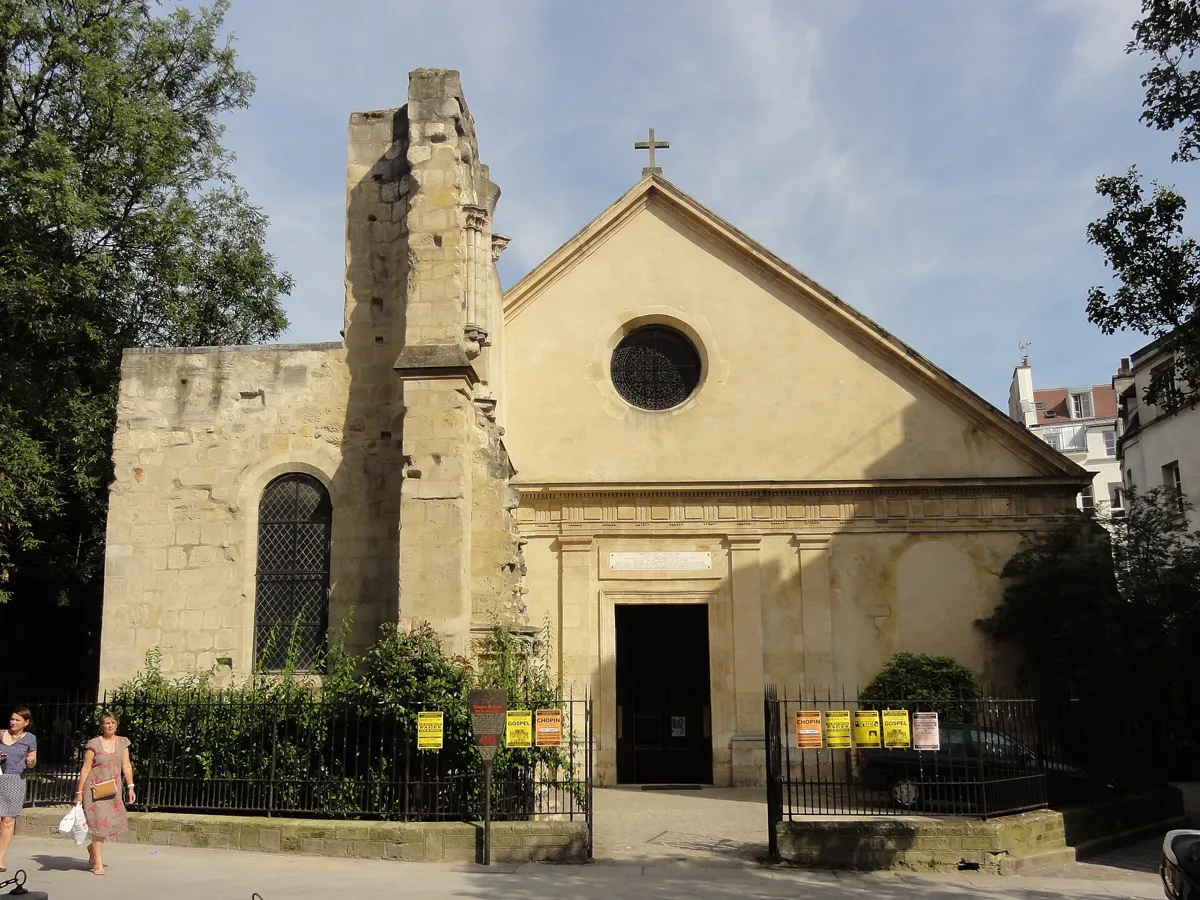
The 1651 west front, on rue Saint-Julien-le-Pauvre. Photo: Pierre Poschadel, CC BY-SA 4.0, via Wikimedia Commons (resized). Keep going along rue de la Bûcherie and turn right into rue Saint-Julien-le-Pauvre, beside the square René-Viviani. The square was laid out in 1928 on the site of an annex of the Hôtel-Dieu hospital. Inside is a false acacia that the botanist Jean Robin is said to have planted in 1601; he brought the species to France, and the tree is usually called the oldest in Paris. The little church at the end of the street was built mostly in the second half of the 12th century and the early 13th. For centuries the University of Paris held its general assemblies here and elected the delegates who chose its rector; in 1524 a riot at one of these votes smashed the doors and windows. By the mid-17th century the church was falling down, so it was cut short by two bays, and the front you see dates from 1651. In the Revolution it was a salt store. Since 1889 it has served Melkite Greek Catholics, who worship in the Byzantine rite.
More history
On 14 April 1921 Tristan Tzara, André Breton and other Dada artists held a "Dada excursion" here, shouting slogans at passers-by. It drew little attention.
Sources: Ministère de la Culture, Mérimée; Wikipedia (fr), Église Saint-Julien-le-Pauvre; Wikipedia, Saint-Julien-le-Pauvre; Wikipedia (fr), Square René-Viviani.
-
Saint-Séverin, the students' parish church
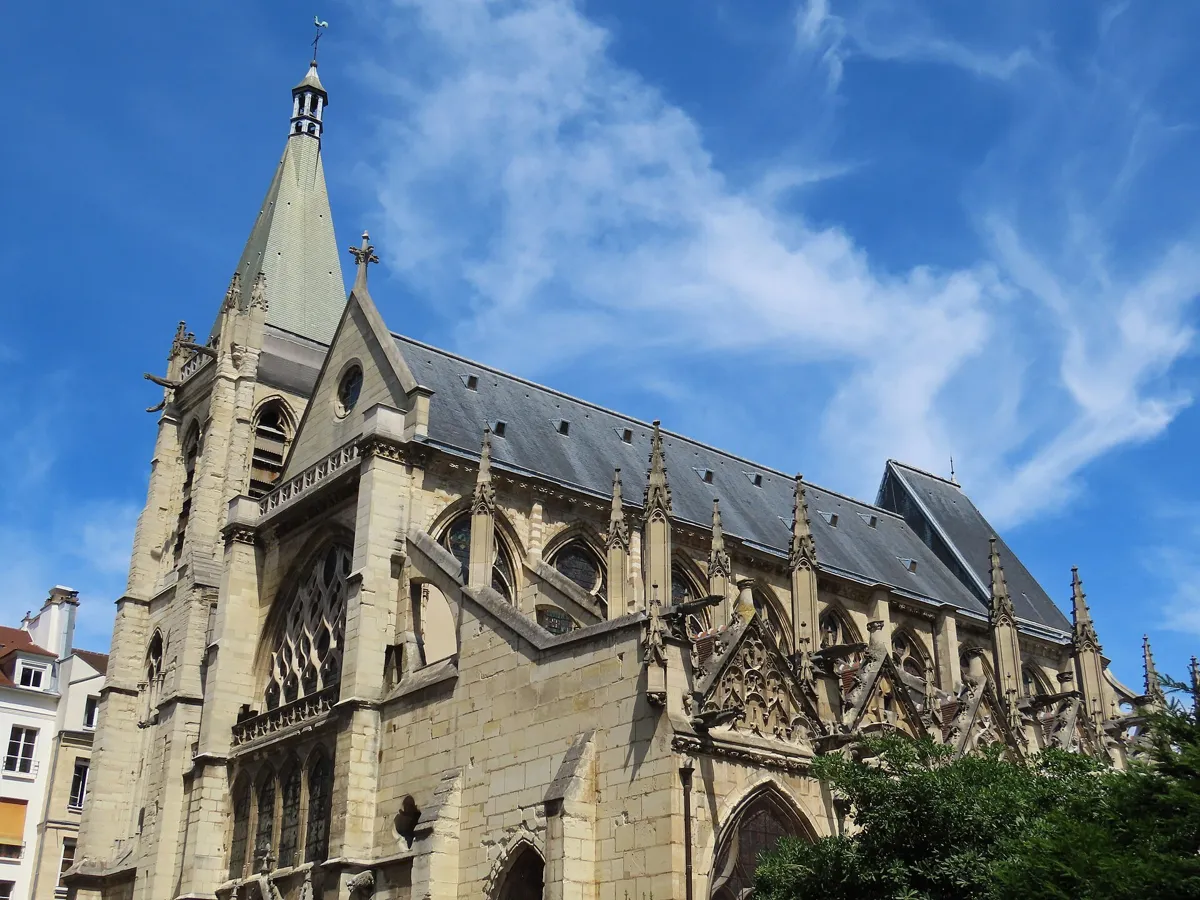
Saint-Séverin and its bell tower. Photo: Rémih, CC BY-SA 4.0, via Wikimedia Commons (resized). Walk west along rue Galande and straight across rue Saint-Jacques into rue Saint-Séverin; the church is on your left. It is named after Séverin, a hermit who prayed here in the 6th century. It became the parish church of the university's students, and a bigger church was begun around 1230. A fire in 1448 badly damaged it, and it was rebuilt in the late, flamboyant Gothic style; the spire was finished in 1487 and the east end from 1489. The lower part of the west door came from another church, Saint-Pierre-aux-Bœufs on the Île de la Cité, and was moved here in 1837 after that church was pulled down. One of the bells, cast in 1412, is the oldest in Paris. If the church is open, step in to see the double walkway round the choir, where the twisted central pillar spreads into the vault like a palm tree.
More history
On the south side is the old charnel house round the former graveyard, now a garden; it is the only one left in Paris.
Sources: Ministère de la Culture, Mérimée; Wikipedia (fr), Église Saint-Séverin; Wikipedia, Saint-Séverin.
-
Musée de Cluny, Roman baths and the abbots' mansion
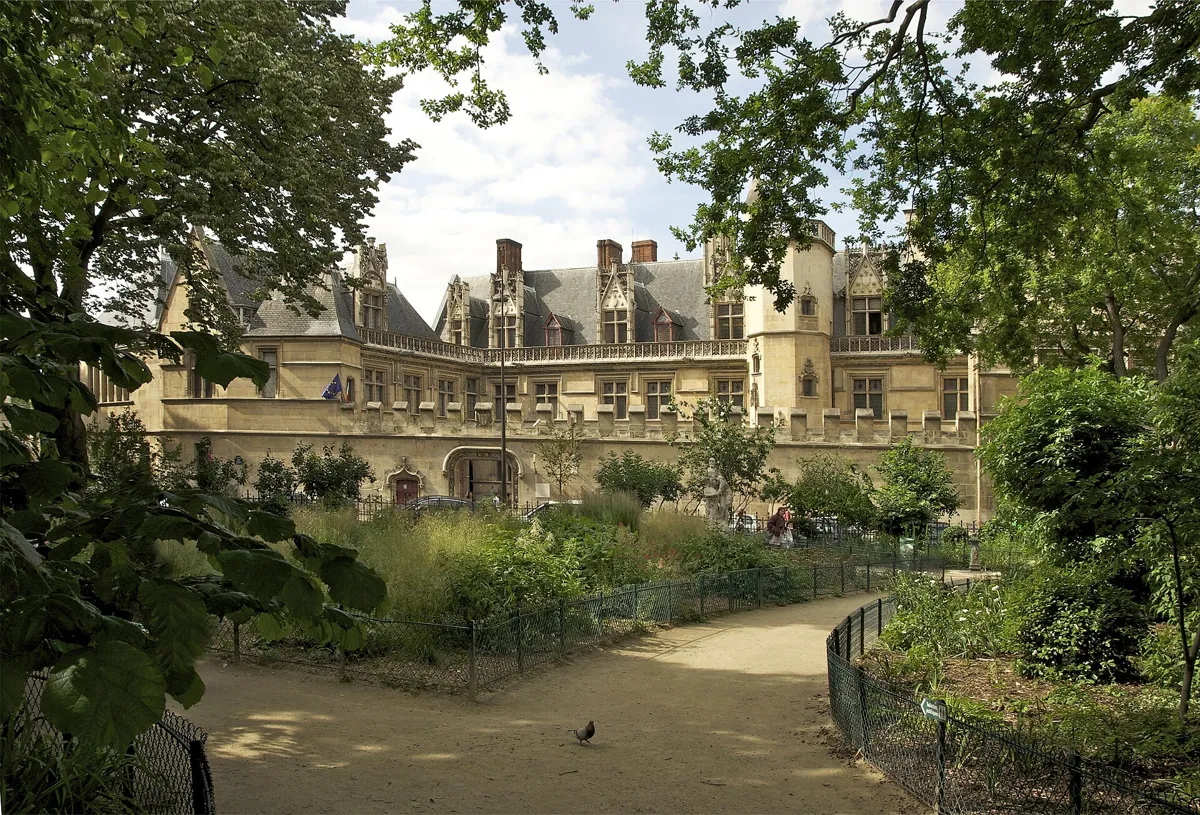
The Hôtel de Cluny from the garden of place Paul-Painlevé. Photo: Jebulon, CC0, via Wikimedia Commons (resized). Continue along rue Saint-Séverin, turn left down rue de la Harpe and right along boulevard Saint-Germain. At boulevard Saint-Michel turn left: the tall Roman walls on your left are the baths' cold room. Then turn left into rue du Sommerard for the museum entrance. The baths were built around the turn of the 1st and 2nd centuries and covered almost 6,000 m²; they were the largest public baths in Roman Paris. Their cold room, the frigidarium, still stands to its full height, with vaults over 14 m high. The abbots of Cluny, in Burgundy, bought the baths in 1340, and from 1485 Abbot Jacques d'Amboise built a Gothic mansion against them, one of the earliest grand private houses in Paris. Mary Tudor, sister of Henry VIII, lived here in 1515 after the death of her husband Louis XII. The collector Alexandre Du Sommerard bought it in 1832, and after his death it opened as a museum in 1843. Its best-known treasure is the set of six 15th-century tapestries, The Lady and the Unicorn. Tickets cost 14 euros; the museum is closed on Mondays.
More history
In the 18th century the astronomer Charles Messier used the mansion's tower as an observatory. After a long renovation, the museum reopened on 12 May 2022.
Sources: Musée de Cluny, the baths; Musée de Cluny, the Hôtel des Abbés; Ministère de la Culture, Mérimée; Wikipedia (fr), Thermes de Cluny; Wikipedia, Musée de Cluny. Visiting: the museum's practical information.
-
The Sorbonne and Richelieu's chapel
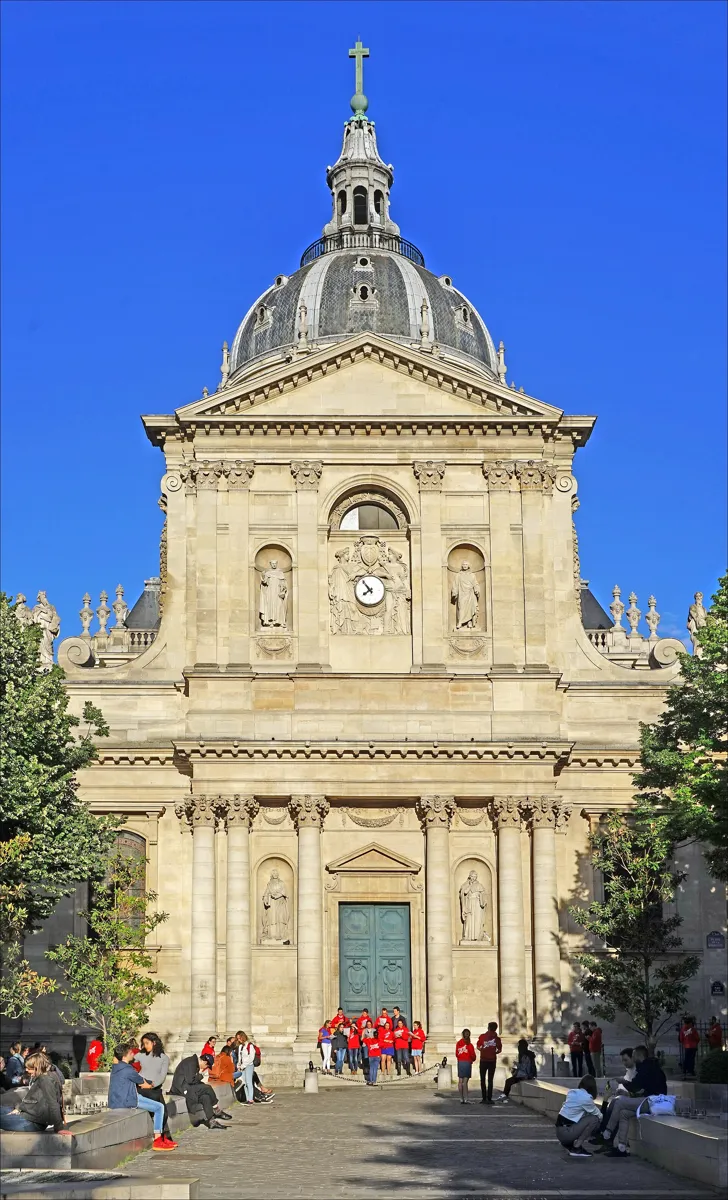
The chapel from place de la Sorbonne. Photo: Jean-Pierre Dalbéra, CC BY 2.0, via Wikimedia Commons (resized). Cross place Paul-Painlevé to rue des Écoles, walk up rue de la Sorbonne and turn into place de la Sorbonne. In 1253 Robert de Sorbon, chaplain to King Louis IX, founded a college here for poor theology students, and the name stuck to the whole university. In 1470 the first printing press in France was set up inside the Sorbonne. Cardinal Richelieu became head of the college in 1622 and had Jacques Lemercier rebuild it. He laid the first stone of the chapel in 1635, and it was finished in 1642, the year he died; he is buried inside under a marble tomb by François Girardon. The chapel is the only part of the old college left. The rest was pulled down and rebuilt by Henri-Paul Nénot from 1885 to 1901. The Sorbonne was a focus of May 1968: on 3 May police cleared students from the Sorbonne's courtyard, and on the night of 10 to 11 May the surrounding streets filled with barricades.
More history
In December 1794 the chapel was ransacked, Richelieu's tomb was vandalised and his body was pulled from the crypt.
Sources: Ministère de la Culture, Mérimée; Wikipedia (fr), Sorbonne; Wikipedia (fr), Chapelle de la Sorbonne; Wikipedia (fr), Place de la Sorbonne; Wikipedia (fr), Quartier latin; Wikipedia, Sorbonne (building).
-
The Panthéon and Saint-Étienne-du-Mont
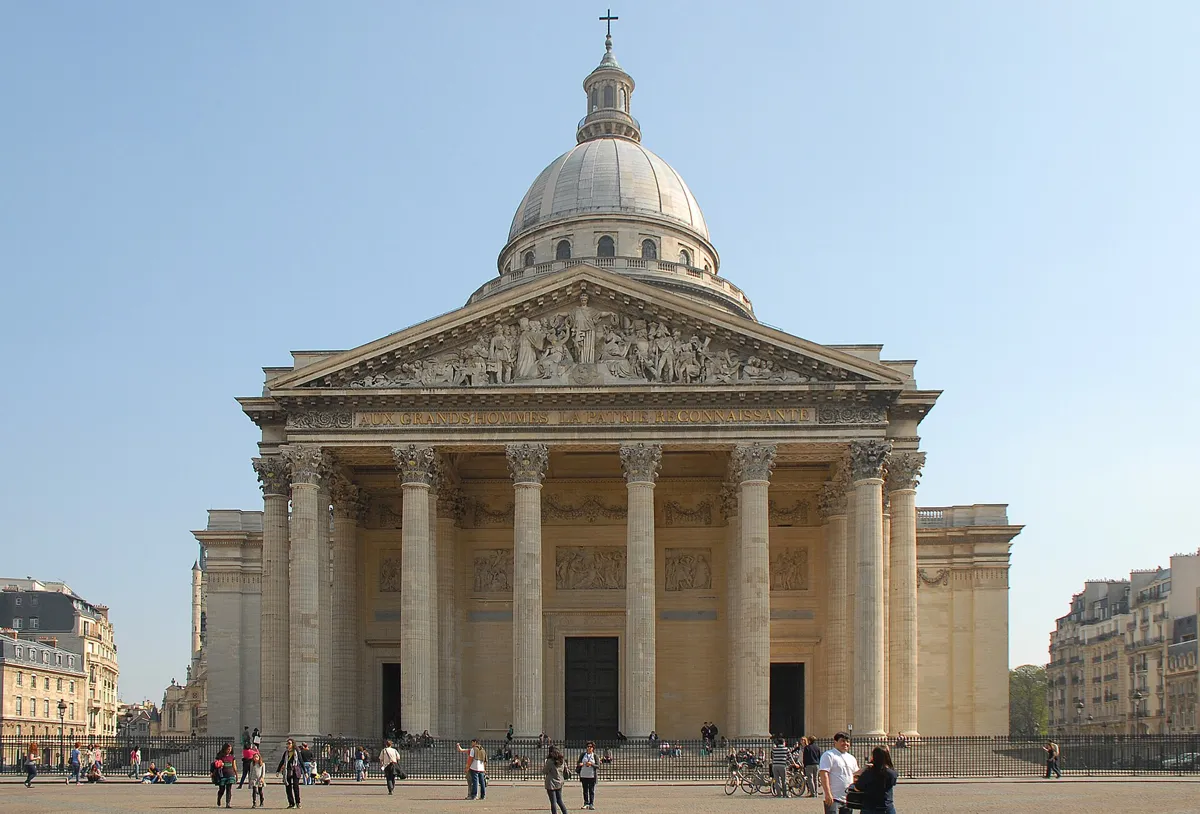
The Panthéon from place du Panthéon. Photo: Camille Gévaudan, CC BY-SA 3.0, via Wikimedia Commons (resized). From the top of the square take rue Victor-Cousin, turn left along rue Cujas, cross rue Saint-Jacques and climb to place du Panthéon. In 1744 Louis XV fell gravely ill at Metz, prayed to St Geneviève, patron saint of Paris, and promised to rebuild her abbey church on this hill. A royal lottery paid for it, and the king laid the first stone on 6 September 1764. Jacques-Germain Soufflot designed it with a Greek-cross plan and a triple dome. He died in 1780, and his team finished it in 1790. A year later the Revolution turned it into a resting place for great men; the inscription on the front reads "To great men, the grateful homeland". It switched between church and Panthéon several times until Victor Hugo's funeral in 1885 settled it. Voltaire and Rousseau, Hugo, Zola and Marie Curie lie in the crypt. Now walk round the north side to place Sainte-Geneviève and the church of Saint-Étienne-du-Mont, consecrated in 1626. It keeps the only rood screen left in Paris, a 16th-century carved stone gallery across the nave, and the tombs of Blaise Pascal and Jean Racine.
More history
In 1851 Léon Foucault hung a 28 kg ball from the dome on a 67 m wire to show the Earth turning; it was reinstalled for good in 1995. Saint-Étienne also keeps St Geneviève's shrine, empty of her relics since the Revolution.
Sources: Centre des monuments nationaux, history of the Panthéon; CMN, the crypt; CMN, Foucault's pendulum; Mérimée, Panthéon; Wikipedia (fr), Panthéon; Wikipedia, Panthéon; Mérimée, Saint-Étienne-du-Mont; Wikipedia (fr), Église Saint-Étienne-du-Mont; Wikipedia, Saint-Étienne-du-Mont. Visiting: the Panthéon's practical information.
-
The Luxembourg Garden and the Fontaine Médicis
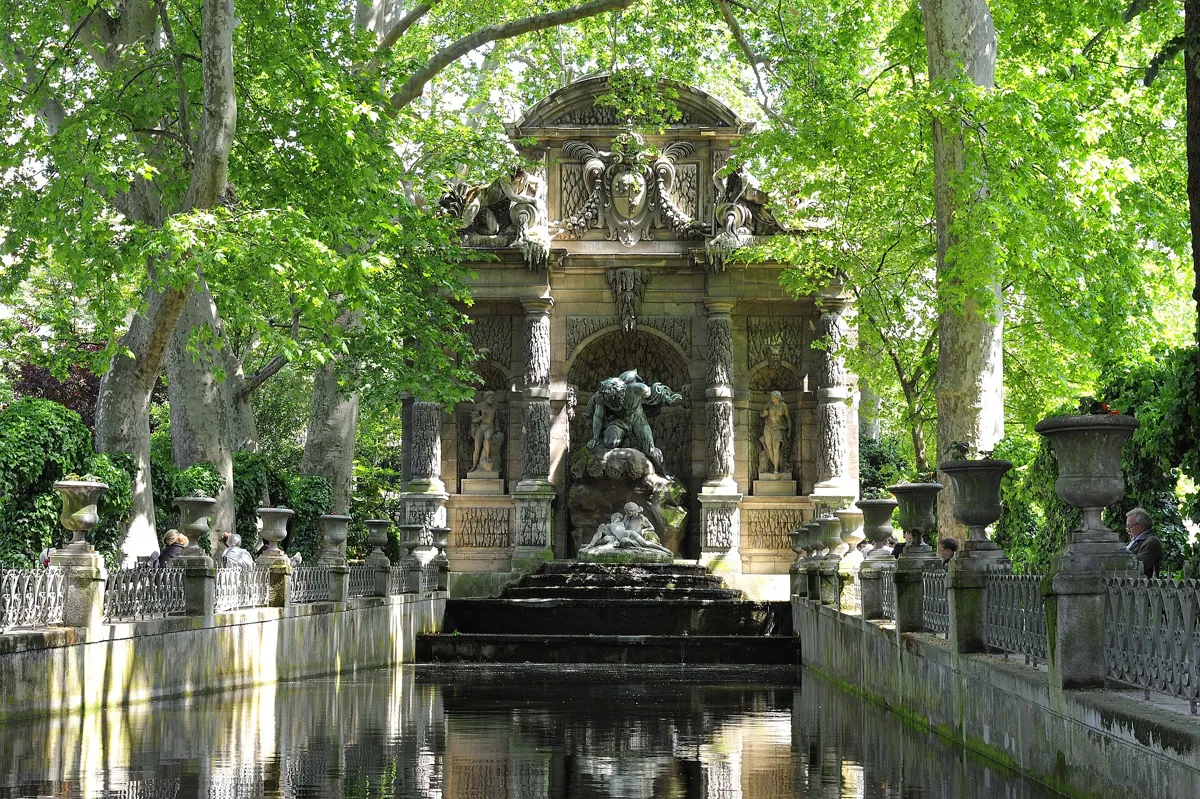
The Fontaine Médicis and its pool. Photo: Rog01, CC BY-SA 2.0, via Wikimedia Commons (resized). Go back to the front of the Panthéon and walk down rue Soufflot, across boulevard Saint-Michel to place Edmond-Rostand. Walk along rue de Médicis and go into the garden; the fountain is a short way inside, at the end of its long pool. After Henri IV died in 1610, his widow Marie de Médicis wanted a palace of her own that would remind her of Italy. She bought the Hôtel de Luxembourg in 1612, Salomon de Brosse designed the palace, and she laid its first stone on 2 April 1615. Around 1630 she had this grotto built, in the style of Italian garden fountains. When Haussmann cut rue de Médicis in 1862, it was moved about 30 m closer to the palace, and Alphonse de Gisors added the 50 m pool and new statues. The palace has mostly housed the upper house of parliament since 1799, and the Senate of the Fifth Republic since 1958. The Senate also runs the garden: about 26 hectares, 102 statues and some 4,500 chairs, free to use since 1974.
More history
In 1741 Rousseau walked in the garden every morning, working his memory on Virgil's eclogues. The garden reached its present edges at the end of the Second Empire.
Sources: Sénat, the Médicis Fountain; Sénat, history of the garden; Sénat, the garden in figures; Mérimée, Palais du Luxembourg; Wikipedia (fr), Palais du Luxembourg; Wikipedia, Luxembourg Palace; Wikipedia, Jardin du Luxembourg; Wikipedia (fr), Jardin du Luxembourg.


Practical details
- Terrain
- Flat along the river, then a steady climb from the Musée de Cluny up the Montagne Sainte-Geneviève to the Panthéon, and gently downhill along rue Soufflot to the garden. Pavements throughout.
- Steps
- OpenStreetMap maps short flights where the route reaches place du Panthéon (up to 12 steps) and in front of Saint-Étienne-du-Mont (3 to 10 steps). The Saint-Michel and Luxembourg stations are marked as wheelchair accessible.
- Water
- OpenStreetMap lists a drinking fountain right outside Shakespeare and Company and others by square René-Viviani, near Saint-Séverin and near the Panthéon.
- Toilets
- A free public toilet, open 24 hours and wheelchair accessible, about 70 m from the Musée de Cluny. The Luxembourg Garden has free toilets in small chalets.
- Sit and eat
- Shakespeare and Company's café, next door to the shop (stop 2); the Café des Amis inside the Musée de Cluny (stop 5); and the refreshment spots and free chairs of the Luxembourg Garden (stop 8).
- Opening hours
- Musée de Cluny: 9:30 to 18:15, closed on Mondays; 14 euros, free on the first Sunday of the month, for under-18s and for EU residents aged 18 to 25. Panthéon: every day, 10:00 to 18:00 from October to March and to 18:30 from April to September, last entry 45 minutes before closing; 13 euros, and the panoramic terrace is closed. Luxembourg Garden in the first half of October: 7:45 to 18:45.
- Shorter walk
- Finish at stop 5, the Musée de Cluny: 1.1 km, about 40 minutes with the stops. Cluny–La Sorbonne metro (line 10) serves the museum.
- Getting back
- Luxembourg RER station (line B) is about 300 m from the fountain, with an entrance on place Edmond-Rostand. Odéon metro (lines 4 and 10) also serves the garden.
Walking distances and times from the OSRM foot router on OpenStreetMap data. Steps, fountains, toilets and stations from OpenStreetMap; opening hours and prices from the Musée de Cluny, the Centre des monuments nationaux and the Sénat. Checked 5 October 2026: check before you go.
Questions people ask
How long does it take to walk the Latin Quarter, and is there a map?
This walk takes about 80 minutes: 2.9 km, 39 minutes of walking and eight stops, from Place Saint-Michel to the Fontaine Médicis in the Luxembourg Garden. Allow more if you go into the Musée de Cluny or the Panthéon. The map is on this page, and you can print it or save it as a PDF.
Why is it called the Latin Quarter?
Because of the university. Teaching at the University of Paris, officially recognised in 1200, was in Latin, and students and teachers spoke it in class and outside until the French Revolution. In the 17th century writers jokingly called the university the pays latin, the Latin country; the name quartier latin appeared in the late 18th century.
What is the Latin Quarter known for?
Universities and books. It sits on the Left Bank in the 5th and 6th arrondissements, on the site of the Roman town of Lutetia, and has been the heart of university life in Paris for more than eight centuries. The first printing press in France was set up in the Sorbonne in 1470. It is also known for the Roman baths at Cluny, the Panthéon, the Shakespeare and Company bookshop and the student protests of May 1968.
Who is buried in the Panthéon?
France's “great men” and, since 1995, great women. Voltaire entered in 1791 and Rousseau in 1794; later came Victor Hugo, Émile Zola, Jean Jaurès, Victor Schœlcher and Jean Moulin. Marie Curie was the first woman to enter for her own merits, in 1995. The crypt holds 81 burials, and half of the people in it are dignitaries of Napoleon's Empire. In June 2026 the historian Marc Bloch and his wife Simonne were honoured with a cenotaph, a memorial without remains; their graves stay in the Creuse.
Is the Luxembourg Garden open to the public, and when?
Yes. It is a public garden run by the French Senate. It opens at 7:30 to 8:15 and closes at 16:30 to 21:30 depending on the season; the times change on the 1st and 16th of each month. The chairs have been free to use since 1974, and the toilets in the garden are free.
Walk it with Strolio
Open Strolio at Place Saint-Michel and ask for 80 minutes through the Latin Quarter. Strolio builds walks in any city with mapped streets, so its route may pick different stops from this page. Stories play as you reach each place, and you can ask about anything else you pass, by voice or with a photo. You can also start from your hotel and choose your own time and interests.
More walks in Paris
- Le Marais: ~80 min, 8 stops. From the medieval city wall and the Place des Vosges to the Jewish quarter on rue des Rosiers.
- Montmartre: ~75 min, 8 stops. From the Moulin Rouge up past Picasso's studio, the last windmills and the vineyard to Sacré-Cœur.
- Île de la Cité to the Louvre: ~80 min, 8 stops. Notre-Dame, the Conciergerie and Sainte-Chapelle, across the Pont Neuf to the Louvre courtyards and the Palais-Royal.
- All Paris walks, with maps side by side.
- Walks in other cities.
Sources
- Ministère de la Culture, POP, Mérimée heritage records: Fontaine Saint-Michel, Saint-Julien-le-Pauvre, Saint-Séverin, Hôtel de Cluny and Roman baths, Sorbonne, Panthéon, Saint-Étienne-du-Mont, Palais du Luxembourg. We used their facts and wrote our own text.
- Official sites: Shakespeare and Company; Musée de Cluny, the baths and the Hôtel des Abbés; Centre des monuments nationaux, history of the Panthéon, the crypt, Foucault's pendulum and Marc and Simonne Bloch (and Ville de Paris, the cenotaph); Sénat, history of the garden, the Médicis Fountain and the garden in figures
- Wikipedia (French): Quartier latin, Place Saint-Michel, Rue de la Huchette, Shakespeare and Company, Square René-Viviani, Église Saint-Julien-le-Pauvre, Église Saint-Séverin, Thermes de Cluny, Sorbonne, Chapelle de la Sorbonne, Place de la Sorbonne, Panthéon, Église Saint-Étienne-du-Mont, Palais du Luxembourg, Jardin du Luxembourg
- Wikipedia (English): Fontaine Saint-Michel, Shakespeare and Company, Saint-Julien-le-Pauvre, Saint-Séverin, Musée de Cluny, Sorbonne (building), Panthéon, Saint-Étienne-du-Mont, Luxembourg Palace, Jardin du Luxembourg
- Opening times and visits: Musée de Cluny, Panthéon, Luxembourg Garden opening hours, Luxembourg Garden practical information
- Map data and places: © OpenStreetMap contributors, ODbL; walking route from the OSRM foot router run by FOSSGIS
- Photos: Wikimedia Commons contributors Guilhem Vellut, Mike Peel, Pierre Poschadel, Rémih, Jebulon, Jean-Pierre Dalbéra, Camille Gévaudan and Rog01, credited under each photo