
Midtown Manhattan self-guided walking tour · 1.5 hours · map
Midtown Manhattan on foot: Grand Central to Times Square by the Chrysler Building, the library lions and Rockefeller Center
Midtown is the Manhattan of postcards. This hour-and-a-half walk starts under the painted sky of Grand Central, looks up at the Chrysler Building, meets the library lions, crosses Bryant Park, then goes up Fifth Avenue to St Patrick's, Rockefeller Center and Radio City before ending on the red steps of Times Square.
Midtown is the central part of Manhattan and the largest central business district in the world. The 1811 plan that laid out the street grid made 42nd Street one of 15 extra-wide crosstown streets, 100 feet across. One habit of the grid helps on foot: Fifth Avenue divides the cross streets into East and West, and house numbers rise in both directions away from it.
A note on accuracy: most buildings on this walk are the originals, but some details are not. Grand Central's sky is a 1940s copy of the first ceiling, and the Times Square steps date from 2008. We say so where it matters, and every fact links to its source. Opening hours change, so check before you go.
- Start
- Grand Central Terminal, 42nd Street at Park Avenue, by Grand Central–42nd Street station
- Finish
- The red steps in Duffy Square, Times Square, Seventh Avenue at 47th Street
- Distance
- 3.4 km (2.1 miles), one way
- Time
- About 1½ hours: 45 min walking and 8 stops, plus any time inside the library or the cathedral
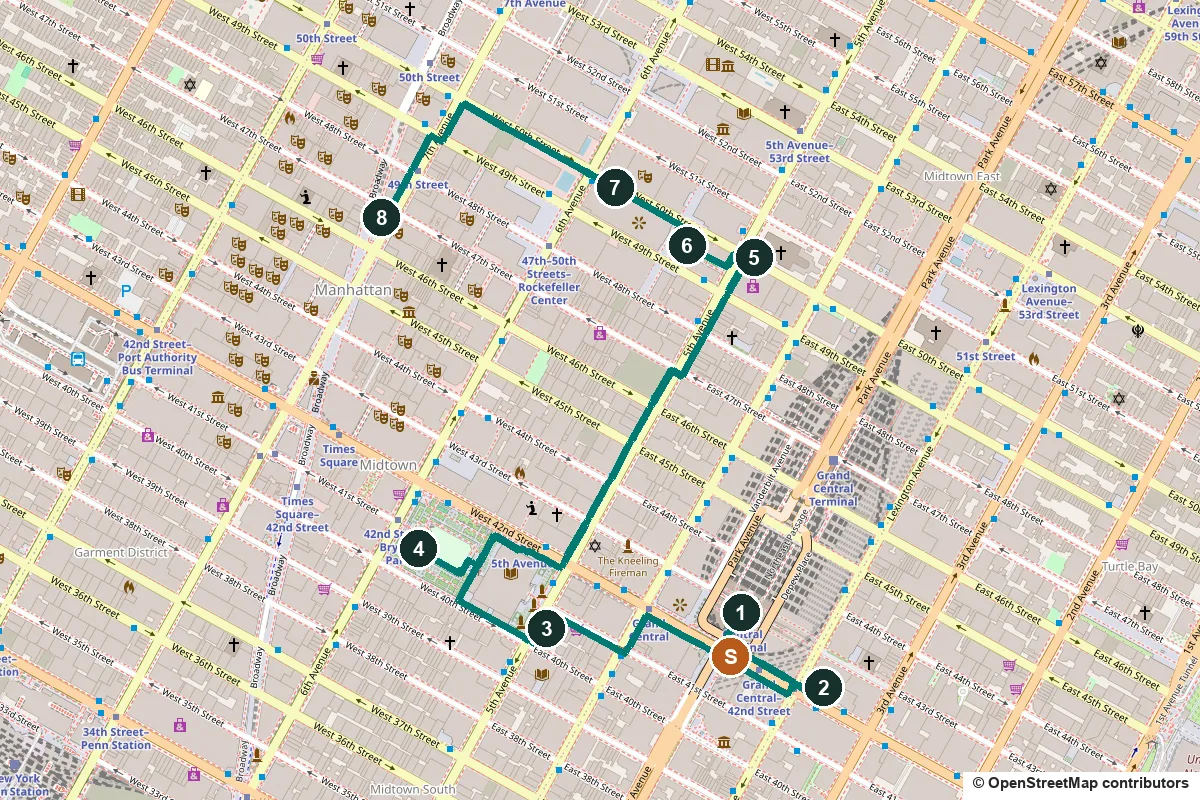
Terrain, toilets, opening hours and a shorter version ↓
What to see: the stops
-
Grand Central Terminal and its back-to-front sky
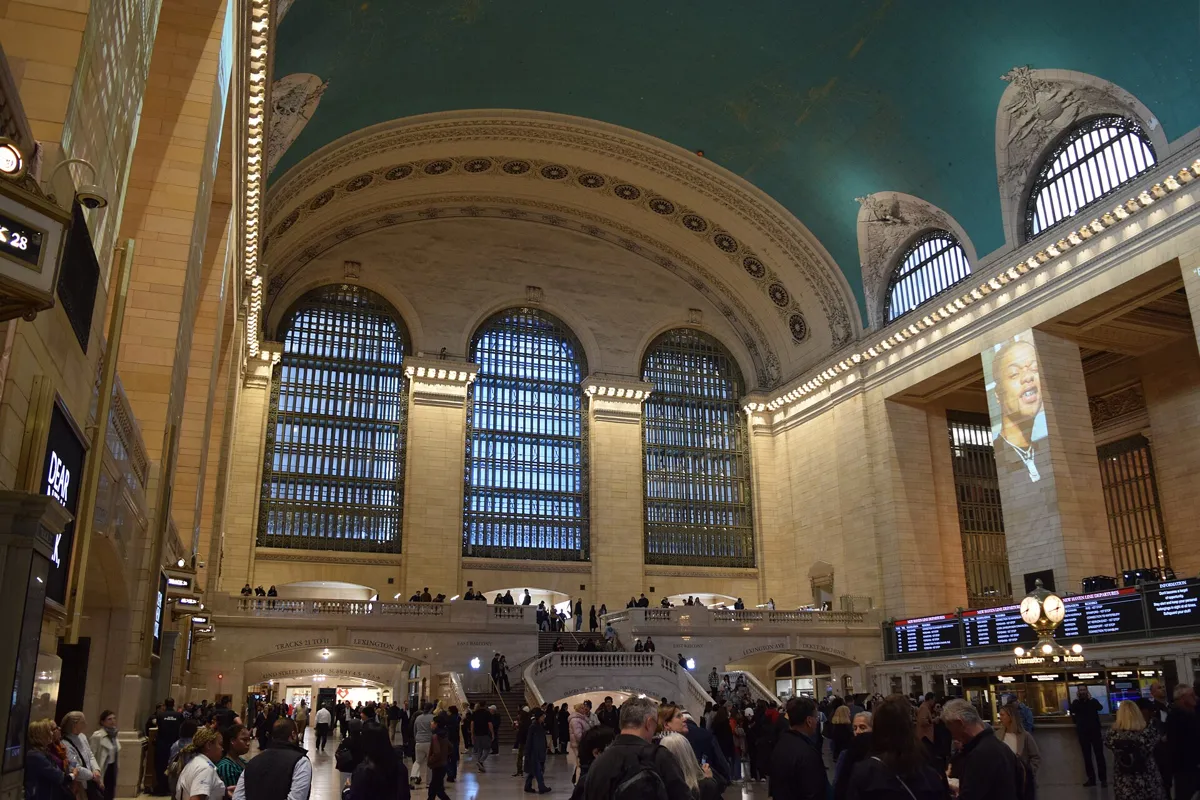
The Main Concourse, with the information booth clock on the right. Photo: TheCatalyst31, CC BY-SA 4.0, via Wikimedia Commons (resized). Go in by the 42nd Street doors under the Park Avenue viaduct and walk straight through the Jacqueline Kennedy Onassis Foyer and Vanderbilt Hall, the old waiting room, into the Main Concourse. The New York Central Railroad built this terminal, which opened on 2 February 1913. The concourse is 38 m high. Look up. The ceiling shows the constellations from Aquarius to Cancer and some 2,500 stars, crossed by gold bands for the ecliptic and the equator. Almost the whole sky is reversed left to right, Orion apart. A commuter spotted the mistake within a month of opening, and it has never been corrected. This is not the 1913 painting: that one leaked and faded, and in 1944 the railroad covered it with boards painted with a simpler copy. When those boards were cleaned from 1996, one dark patch near Cancer the crab was left dirty on purpose. On the information booth in the middle stands a four-faced brass clock; its faces are opalescent glass, not the precious opal of a well-worn legend.
More history
In 1968 the struggling New York Central merged into Penn Central, which planned to replace the terminal with a skyscraper, as had happened to Penn Station in 1963. The city's Landmarks Preservation Commission, which had designated Grand Central in 1967, refused, and the Supreme Court ruled for the city. The foyer you walked through has carried Jacqueline Kennedy Onassis's name since 2014 because she helped fight the demolition. By the Oyster Bar ramps, under the bridge, is a whispering gallery: stand in opposite corners and speak softly.
Sources: Wikipedia, Grand Central Terminal; Wikipedia, Main Concourse; Wikipedia, Grand Central Terminal art; Landmarks Preservation Commission, designation report (1967). Visiting: Grand Central Terminal FAQ.
-
The Chrysler Building, briefly the tallest in the world
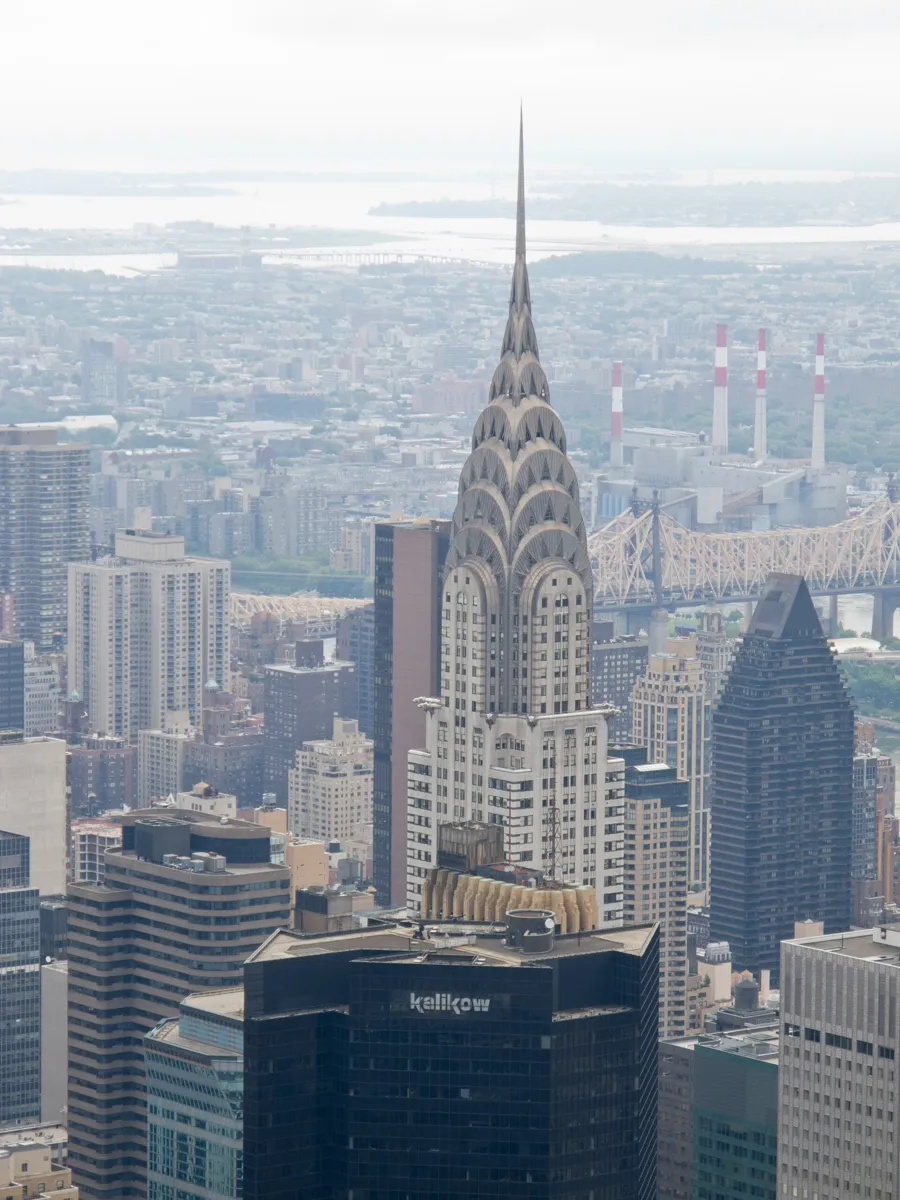
The crown and spire. Photo: Carlos Delgado, CC BY-SA 3.0, via Wikimedia Commons (resized). Walk back out to 42nd Street, turn left and walk east to Lexington Avenue. Cross Lexington and look up from the south side of 42nd Street. William Van Alen designed this Art Deco tower for Walter Chrysler, who paid for it himself as an investment for his children. Racing 40 Wall Street for the title of world's tallest building, Van Alen had a steel spire built in secret inside the top, and on 23 October 1929 it was raised into place, in about 90 minutes by one account. At 319 m (1,046 ft) the building, opened on 27 May 1930, was the tallest in the world and the first structure over 1,000 feet, until the Empire State Building opened on 1 May 1931. Look for car parts in steel: at the 31st floor, corner ornaments based on 1929 Chrysler radiator caps and a frieze of hubcaps and fenders; at the 61st floor, eagles. The lobby, with Edward Trumbull's ceiling mural, was by the 2000s the only part open to the public. It is a working office lobby with a security desk, so whether you can step in is not guaranteed.
More history
Walter Chrysler later refused to pay the rest of Van Alen's fee, claiming he had taken bribes from suppliers. Van Alen sued and won, but the case and the Depression ruined his career; he ended up teaching sculpture. The land belongs to the Cooper Union, a college, which the building has paid for its use since it opened.
Sources: Wikipedia, Chrysler Building; Landmarks Preservation Commission, designation report (1978).
-
The New York Public Library and its lions, Patience and Fortitude
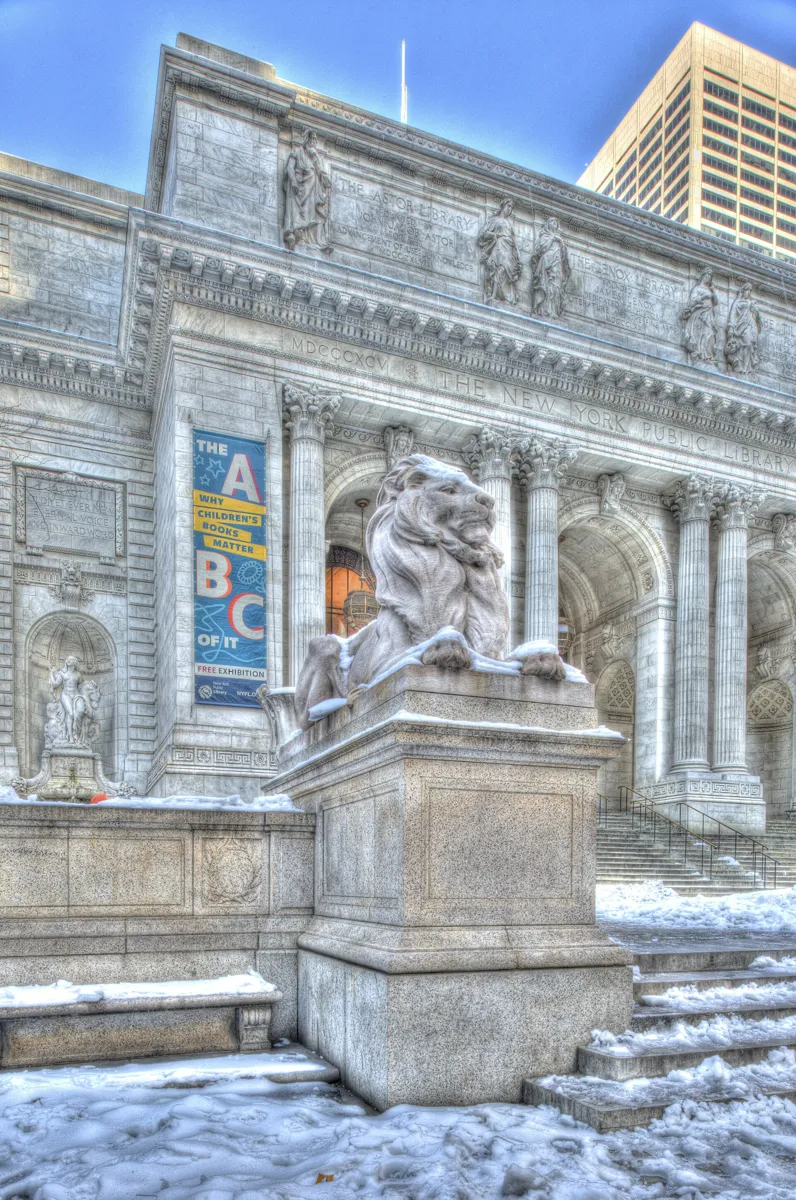
One of the two lions on Fifth Avenue. Photo: Bestbudbrian, CC BY-SA 3.0, via Wikimedia Commons (resized). Walk back west along 42nd Street, past the front of Grand Central, to Madison Avenue. Turn left for one block, then right into 41st Street. This block is Library Way: the bronze plaques set into the pavement carry quotations from writers. At the end, cross Fifth Avenue to the library steps. The building stands on the site of the old Croton Reservoir. Carrère and Hastings, then a little-known firm, won the design competition in 1897, and the library opened on 23 May 1911 with President Taft at the ceremony; it was then the largest marble building in the United States. The two marble lions by the steps got their nicknames, Patience and Fortitude, from Mayor Fiorello La Guardia in the 1930s: the qualities he thought New Yorkers would need to get through the Depression. Patience is on the left (south) as you face the steps, Fortitude on the right. The building has carried Stephen A. Schwarzman's name since 2008, after his $100 million gift.
More history
The lions were first called Leo Astor and Leo Lenox, in honour of the library's founders. Remains of the reservoir are still in the cellar.
Sources: Wikipedia, New York Public Library Main Branch. Visiting: NYPL, Stephen A. Schwarzman Building; NYPL, tours; NYPL, plan your visit.
-
Bryant Park, from paupers' graveyard to Midtown's lawn
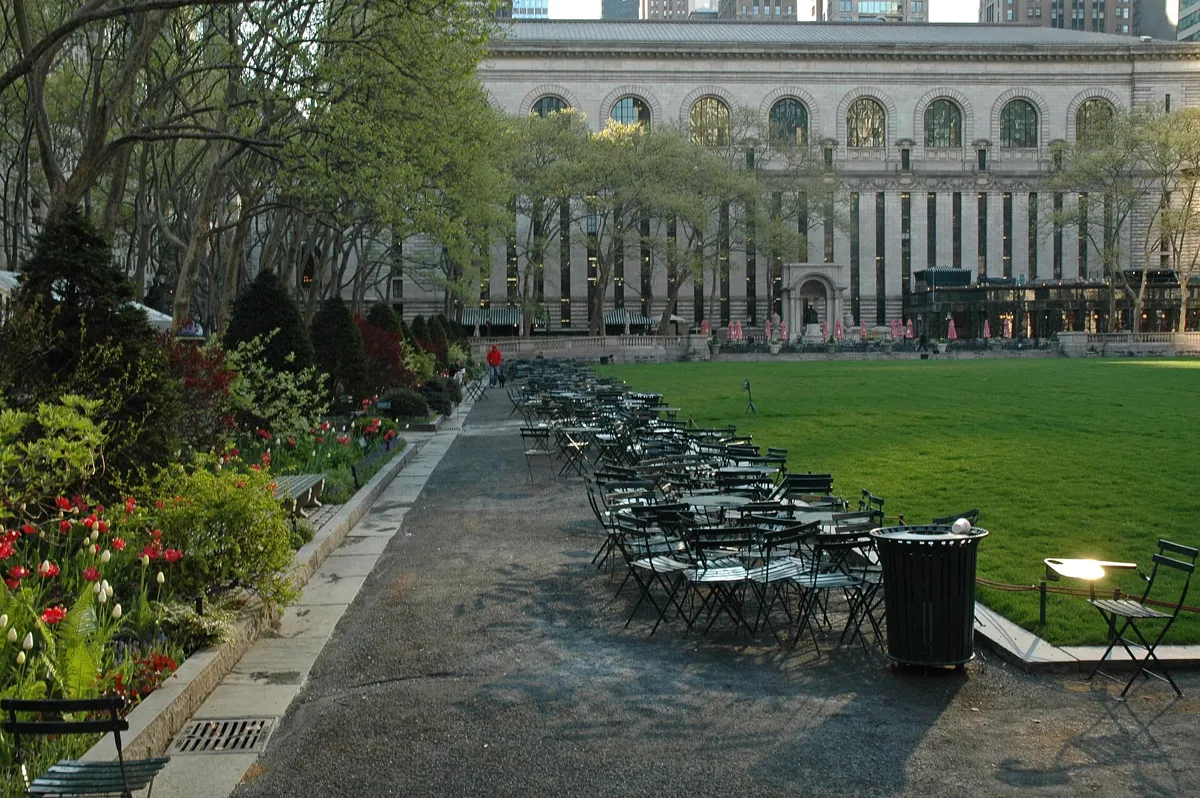
The lawn and the library's back wall, with Bryant's statue in the niche. Photo: Leifern, CC BY-SA 3.0, via Wikimedia Commons (resized). Walk down Fifth Avenue to 40th Street, turn right along the library's south side, and go into Bryant Park by the carousel, then on to the lawn. In 1686 the colonial governor Thomas Dongan made this land public. From 1823 to 1840 it was a potter's field, a graveyard for the poor. The first park opened in 1847 as Reservoir Square, and in 1853 it held the New York Crystal Palace, a glass-and-iron hall for the Exhibition of the Industry of All Nations, which burned down in 1858. In 1884 the square was renamed after William Cullen Bryant, poet, abolitionist and editor of the New York Evening Post; his statue sits under a little dome on the library's back wall. By the late 1970s the park was known for drug dealing. A private non-profit closed it in 1988, lowered it nearer street level, put out movable chairs and reopened it in April 1992. Under the lawn, built during that closure, are the library's book stacks.
More history
Next to the Crystal Palace stood the Latting Observatory, a 315-foot iron and wood tower, which burned in 1856.
Sources: Bryant Park Corporation, history; Wikipedia, Bryant Park. Hours: Bryant Park, hours and directions.
-
St Patrick's Cathedral, and Atlas across the avenue
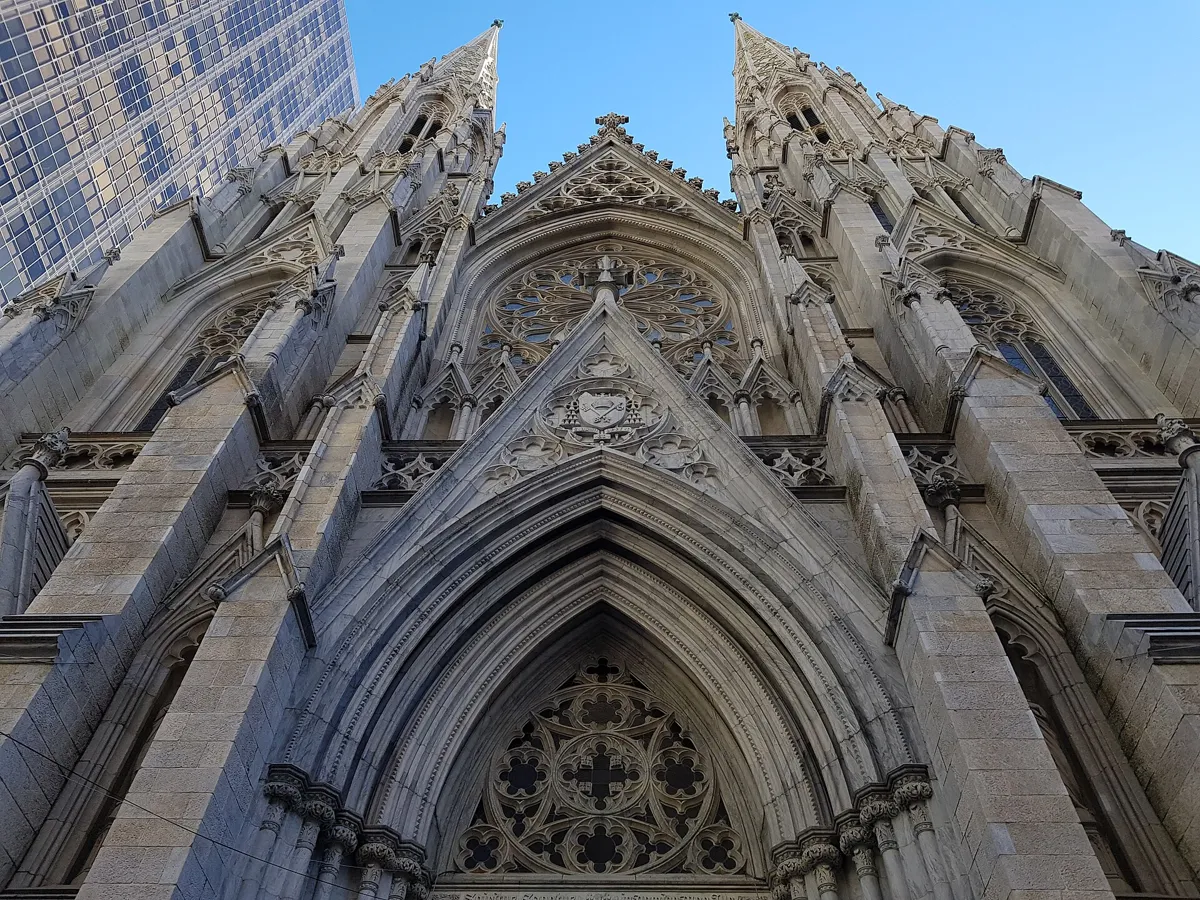
The Fifth Avenue front. Photo: Sebring12Hrs, CC BY-SA 4.0, via Wikimedia Commons (resized). Leave the park on the 42nd Street side by the restrooms, turn right to Fifth Avenue and turn left. Walk north up Fifth Avenue, crossing to the east side at 47th Street, to the cathedral between 50th and 51st Streets. Archbishop John Hughes wanted a cathedral to replace the old one on Mulberry Street, downtown. James Renwick Jr. designed it, and Hughes laid the cornerstone on 15 August 1858 before about 100,000 people. The money ran out in 1860 and the Civil War stopped work; the cathedral was dedicated on 25 May 1879, and the spires, 100 m high, were finished in 1888. It is clad in marble and is the largest Gothic Revival Catholic cathedral in North America. The bronze doors, from 1949, weigh about 4,200 kg each; above them is a rose window 7.9 m across. The cathedral opens daily from 6:45 am to 8:45 pm and is a working church, so Mass may be on. Turn round: across Fifth Avenue, in the courtyard of the International Building, Lee Lawrie's bronze Atlas, installed in 1937, holds up the heavens facing the cathedral.
More history
The cathedral was consecrated on 5 October 1910, once its debts were paid. Just inside the doors, Adam Cvijanovic's mural of immigrants arriving in New York was installed in 2025.
Sources: Wikipedia, St. Patrick's Cathedral; Wikipedia, Atlas (statue). Visiting: St Patrick's Cathedral, FAQs; official tours.
-
Rockefeller Center: the Channel Gardens, Prometheus and the rink
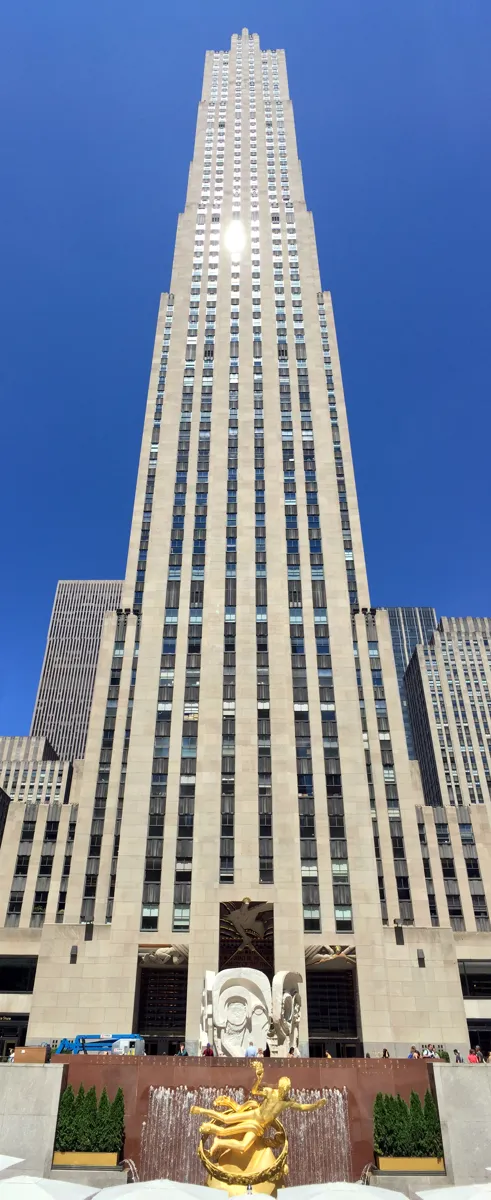
Prometheus and 30 Rockefeller Plaza. Photo: Huwmanbeing, public domain, via Wikimedia Commons (resized). Cross Fifth Avenue and walk west down the Channel Gardens, the planted walk between La Maison Française and the British Empire Building, to the edge of the sunken plaza. John D. Rockefeller Jr. leased this land from Columbia University in 1928 for a new Metropolitan Opera house. When the opera could not afford to move, the plan became 14 Art Deco office and entertainment buildings, started in 1931 and mostly finished by 1939. Below is the Lower Plaza. Paul Manship's gilded bronze Prometheus, 5.5 m tall, from 1934, brings fire to humankind. The ice rink was installed in 1936 to replace shops down here that did not pay. This season it opens on 10 October. Behind rises 30 Rockefeller Plaza, finished in 1933; above its main entrance Lee Lawrie's carved Wisdom is accompanied by a line from Isaiah, "Wisdom and Knowledge shall be the stability of thy times". Its observation deck, Top of the Rock, sits 850 feet (260 m) above the street.
More history
Diego Rivera's fresco for the lobby of 30 Rockefeller Plaza, Man at the Crossroads, included a portrait of Lenin. Nelson Rockefeller asked him to replace it; Rivera refused, was paid, and the fresco was covered and later destroyed. Josep Maria Sert's American Progress hangs there now.
Sources: Wikipedia, Rockefeller Center; Wikipedia, Prometheus (Manship); Wikipedia, 30 Rockefeller Plaza; Landmarks Preservation Commission, designation report (1985). Visiting: The Rink; Top of the Rock.
-
Radio City Music Hall, the Showplace of the Nation
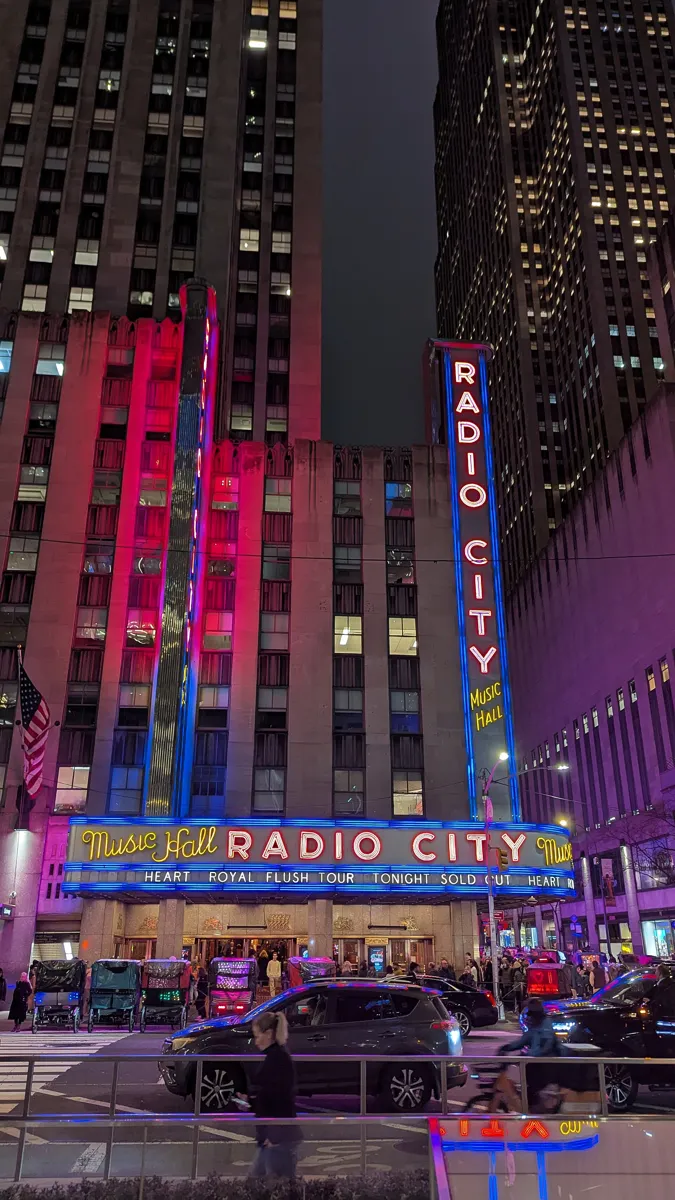
The marquee and sign on Sixth Avenue. Photo: Eden, Janine and Jim from New York City, CC BY 2.0, via Wikimedia Commons (resized). Walk north up Rockefeller Plaza, the private street beside the rink, to 50th Street and turn left, past the Top of the Rock entrance, to Sixth Avenue. The marquee wraps round the corner. Radio City opened on 27 December 1932. Edward Durell Stone designed it and Donald Deskey designed the Art Deco interiors; its 5,960-seat, four-tier auditorium was the largest in the world, and the stage's great arch is shaped like a setting sun. The opening show ran from 8 pm to 2 am and flopped. Within weeks the hall switched to films with a stage show, a format it kept into the 1970s, with many film premieres. It is the home of the Rockettes. In the late 1970s it nearly closed. Performers campaigned to save it, the city made it a landmark in May 1978, and it stayed open. Guided tours of about an hour are sold through its website.
More history
In the early 1970s Radio City still drew five million visitors a year, more than the Empire State Building and the Statue of Liberty combined.
Sources: Wikipedia, Radio City Music Hall. Tours: Radio City Music Hall Tour Experience.
-
Times Square and the red steps of Duffy Square
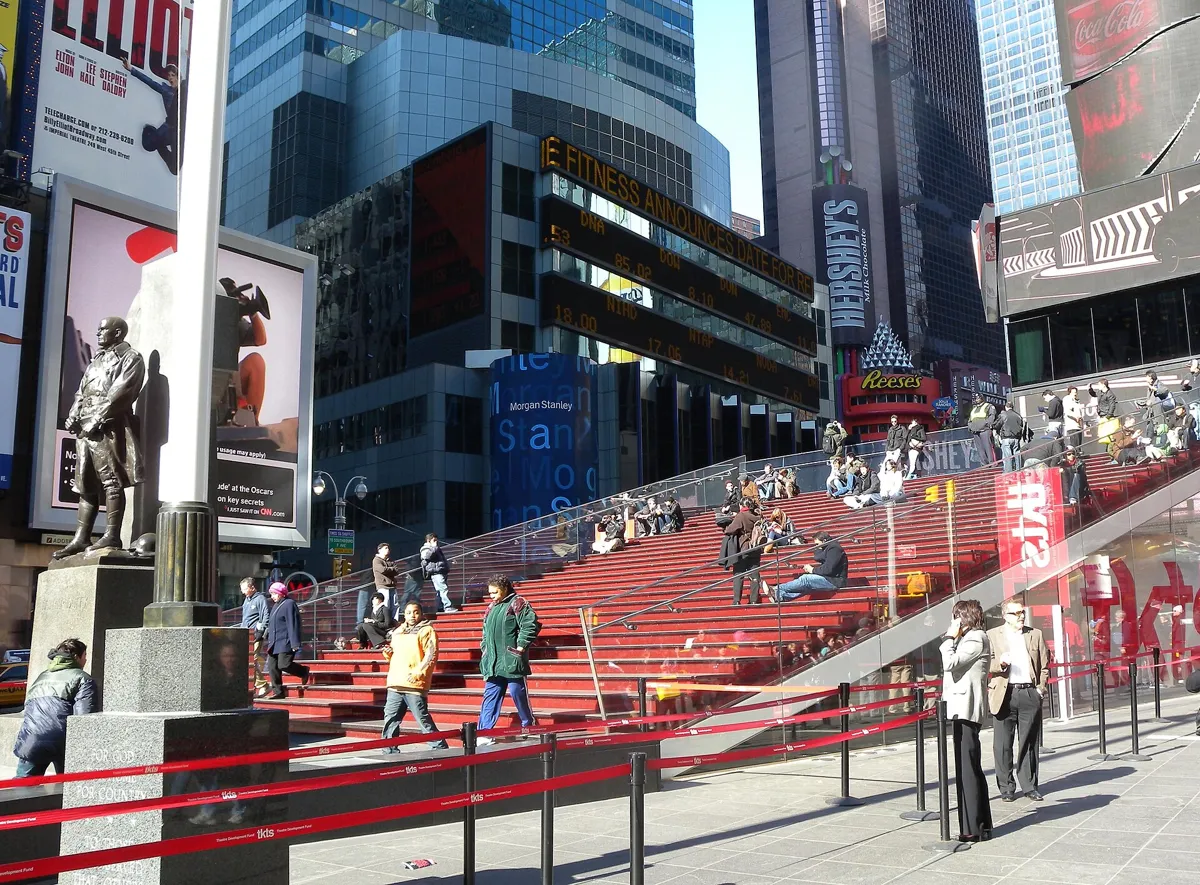
The red steps over the TKTS booth in Duffy Square. Photo: Jim.henderson, public domain, via Wikimedia Commons (resized). Cross Sixth Avenue and walk west along 50th Street to Seventh Avenue, then turn left down Seventh Avenue to the red steps at 47th Street. This was Longacre Square, centre of the city's horse-carriage trade, until The New York Times moved into a new tower on 42nd Street; on 8 April 1904 the square took the paper's name. The New Year's Eve ball first dropped on 31 December 1907, from the roof of that tower, now One Times Square. Strictly, Times Square is the southern triangle below 45th Street. The northern one, where you stand, is Duffy Square, named in 1939 after Father Francis P. Duffy, a First World War chaplain whose statue stands here. The TKTS booth has sold cut-price same-day theatre tickets here since June 1973, and since 2008 the red steps have risen above it. Since 1987 zoning has required buildings here to show illuminated signs, the only district in the city with that rule. In 2009 Broadway from 42nd to 47th Street was closed to cars; it is now a granite pedestrian plaza, and about 330,000 people pass through the square each day.
More history
On 15 August 1945 an estimated two million people, the largest crowd in the square's history, gathered here to celebrate victory over Japan.
Sources: Wikipedia, Times Square.


Practical details
- Terrain
- Almost flat: Midtown has no real hills, and the only climbs are the steps listed below. Busy pavements and plazas all the way, with long crossings of wide avenues.
- Step-free
- Mostly, but not completely. OpenStreetMap maps flights of steps beside the route: a 20-step flight near Grand Central's 42nd Street entrance, flights of 2 to 8 steps around Bryant Park, the library's front steps, and a 12-step flight beside Prometheus at Rockefeller Center. We did not check each one for a ramp or lift. The library has a ramp entrance on 42nd Street and a street-level entrance on 40th Street, and St Patrick's has a wheelchair ramp on 51st Street. At the start, OpenStreetMap tags the Grand Central–42nd Street station as step-free.
- Water
- OpenStreetMap maps four drinking fountains near the route, all tagged wheelchair accessible: two by Grand Central's 42nd Street entrance (about 70 to 80 m away) and two in Bryant Park (within about 110 m of the lawn). We did not check that they are switched on, so carry a bottle as well.
- Toilets
- Bryant Park (stop 4) has staffed public restrooms on 42nd Street, open daily 8 am to 10 pm, and a second block near the carousel on 40th Street with an accessible toilet. The library has restrooms too, added in its 2023 renovation. OpenStreetMap also maps toilets in Grand Central, by the Prometheus plaza at Rockefeller Center and in the M&M store near Duffy Square; we did not check their hours.
- Sit and eat
- Bryant Park's movable chairs and tables are the best rest stop. Grand Central has a food hall and the Dining Concourse below the Main Concourse, and the library has a shop and café.
- When to go
- Grand Central opens daily 5:15 am to 2 am. Bryant Park opens daily from 7 am, until 10 pm in October. The library's reading room has a visiting hour at 10 am, Monday to Saturday; free tours run at 11 am and 2 pm. St Patrick's opens daily 6:45 am to 8:45 pm. Top of the Rock opens 8 am to midnight, tickets from $42. The Rockefeller Center rink opens for the season on 10 October 2026.
- Shorter walk
- Stop after Bryant Park (stop 4): 1.4 km, about 18 minutes of walking, four stops. Bryant Park's site lists the B, D, F and M trains at 42nd Street–Bryant Park and the 7 at Fifth Avenue. Or start at Bryant Park and do stops 5 to 8: 2.0 km, about 27 minutes of walking.
- Getting back
- To return to Grand Central, walk south on Seventh Avenue to 42nd Street and then east; from Broadway at 42nd Street the OSRM foot router gives about 930 m, 12 minutes. By subway, OpenStreetMap shows an entrance 37 m from the red steps (tagged not step-free), the 49th Street station 108 m away (step-free access tagged "limited"), and the 50th Street and 47th–50th Streets–Rockefeller Center stations about 300 m away (tagged not step-free). Check the MTA for current lift status.
Walking distances and times from the OSRM foot router on OpenStreetMap data. Stations, fountains, toilets and steps from OpenStreetMap; opening hours from Grand Central Terminal, the New York Public Library, Bryant Park, St Patrick's Cathedral and Rockefeller Center. Checked 5 October 2026.
Questions people ask
Is Midtown Manhattan walkable?
Yes. This route is 3.4 km (2.1 miles) with about 45 minutes of actual walking, all on pavements and plazas, and it is almost flat, with no real hills. The street grid helps: Fifth Avenue divides the cross streets into East and West, and house numbers rise in both directions away from it. Allow about an hour and a half with the stops.
Can you go inside Grand Central for free?
Yes. Grand Central Terminal is open to the public every day from 5:15 am to 2 am, and you can walk into the Main Concourse to see the starry ceiling and the clock on the information booth. Only the guided tours are paid; the terminal's site lists a 90-minute tour from $35.
Can you visit the Chrysler Building lobby?
Sometimes. The lobby, with its red granite walls and Edward Trumbull's ceiling mural, was the only part of the building open to the public by the 2000s. It is a working office lobby with a security desk, and we found no official page with current visiting hours, so treat access as a bonus. The building itself is best seen from 42nd Street and Lexington Avenue, which costs nothing.
How long does it take to walk from Grand Central to Times Square?
About 12 minutes straight along 42nd Street: the OSRM foot router puts the 42nd Street door of Grand Central 930 m from Times Square at Broadway. This walk takes the long way round, 3.4 km and about 45 minutes of walking, by the Chrysler Building, the library, Bryant Park, St Patrick's, Rockefeller Center and Radio City.
Is the New York Public Library free?
Yes. The Treasures exhibition in the Stephen A. Schwarzman Building is free, and so are the one-hour building tours at 11 am and 2 pm, Monday to Saturday, booked online. To see the Rose Main Reading Room without a tour, come for the visiting hour, 10 to 11 am, Monday to Saturday. Last entry to the building is 15 minutes before closing; check the hours on nypl.org.
Walk it with Strolio
Open Strolio at Grand Central and ask for an hour and a half through Midtown to Times Square. Strolio builds walks in any city with mapped streets, so its route may pick different stops from this page. Stories play as you reach each place, and you can ask about anything else you pass, by voice or with a photo. You can also start from your hotel and choose your own time and interests.
More walks in New York
- Lower Manhattan: ~2 h, 8 stops. Where New York began: from the Battery past Wall Street, Hamilton's grave and the 9/11 Memorial to the Brooklyn Bridge.
- Central Park: ~1½ h, 8 stops. South to north: the Pond, the Mall, Bethesda Fountain, Strawberry Fields, Bow Bridge and Belvedere Castle to the Reservoir.
- All New York walks, with maps side by side.
- Walks in other cities.
Sources
- New York City Landmarks Preservation Commission designation reports: Grand Central Terminal (1967), Chrysler Building (1978), Rockefeller Center (1985). We used their facts and wrote our own text.
- Official sites: Grand Central Terminal, New York Public Library, Bryant Park, St Patrick's Cathedral, Rockefeller Center, Radio City Music Hall
- Wikipedia: Midtown Manhattan, 42nd Street, Fifth Avenue, Grand Central Terminal, Main Concourse, Grand Central Terminal art, Chrysler Building, New York Public Library Main Branch, Bryant Park, St. Patrick's Cathedral, Atlas, Rockefeller Center, Prometheus, 30 Rockefeller Plaza, Radio City Music Hall, Times Square
- Map data and places: © OpenStreetMap contributors, ODbL; walking route from the OSRM foot router run by FOSSGIS
- Photos: Wikimedia Commons contributors TheCatalyst31, Carlos Delgado, Bestbudbrian, Leifern, Sebring12Hrs, Huwmanbeing, Eden, Janine and Jim, and Jim.henderson, credited under each photo